Autonomous research with inspectable evidence
Simjecture · Autonomous numerical research
Bring a hypothesis and the conditions that matter. Let an agent design experiments, search for counterexamples and test a better explanation—with recorded evidence and independent review.
How research moves forward
- Frame the questionYou and the agent agree on the hypothesis, physical scope and budget.
- Run experimentsThe agent chooses methods and runs recorded numerical computations.
- Look for a failureChallenge the prediction and check candidate counterexamples.
- Commit a repairPreserve the failed claim and state a justified replacement before testing it.
- Collect fresh evidenceRun the committed tests and challenge the revised prediction.
- Review the conclusionA separate context examines the claim, source, results and numerical controls.
Review gaps return the agent to investigation. Human steering can change the next experiment. The selected completion policy determines whether a falsification finishes the study or starts a repair; the deadline can leave it incomplete.
See the process in a real record
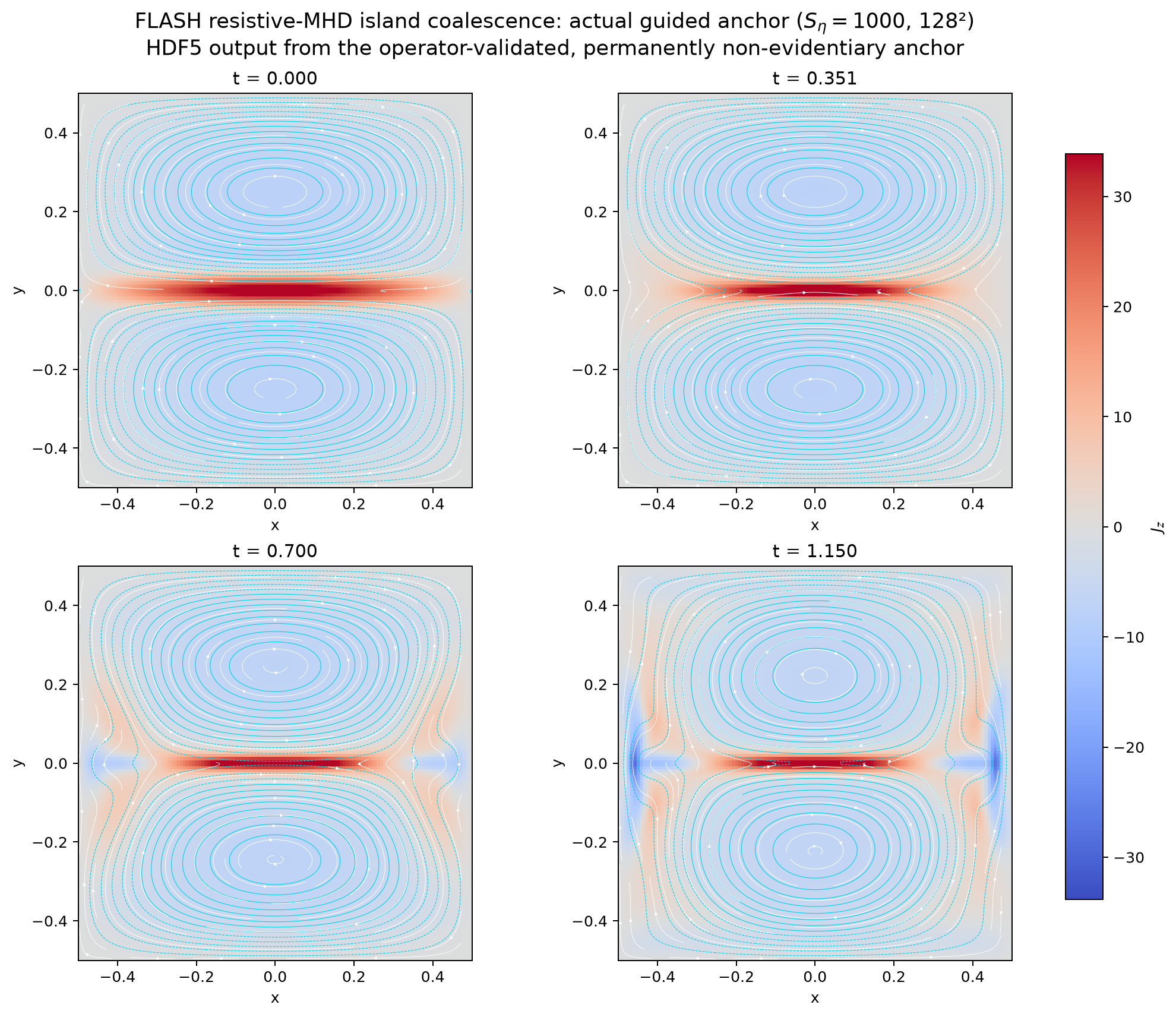
The FLASH island-coalescence study asks whether one reconnection-rate scaling survives changes in resistivity and resolution. Follow real plasma fields, the original campaign’s audit and a fresh minimal-mode investigation.
For a short, fully inspectable example, the orbital-accuracy investigation found five counterexamples and supported a narrower claim with fresh numerical tests and independent review. Ordinary CPU Python is enough to reproduce its experiments.
The FLASH-to-WarpX investigation connects a measured MHD current sheet to local kinetic calculations. It records successful state transfer and completed numerical controls, with the scientific claim unresolved at the two-hour cutoff.
Prepare a brief, choose a completion policy and follow a study through experiments and review.
Understand the recordWhy should you trust this result?Trace a conclusion to its numerical inputs, outputs, counterexamples and review decisions.
Bring a scientific toolStart from a working instrumentGive the agent a verified example, source access, diagnostics and clear physical limits.
Keep exploringGuide the next experimentSteer at a checkpoint or open a linked continuation with a revised brief and new budget.
Choose your working environment
Use the hosted workspace with supplied inference and compute within usage limits, or install locally and choose your own API or native CLI agent. You can run ordinary Python studies, add scientific capabilities, and use SSH workers for numerical experiments. Server mode supports an operated service with per-visitor allowances.
The sidebar identifies the documentation build version. Current walkthroughs and historical records are labelled separately. See research status, release checks, or contribute a tool or study.