Autonomous collisionless GEM run 0004
Run 0004 is the strongest completed end-to-end plasma stress test in the 0.1 research preview. It was a guided autonomous campaign: the operator supplied a validated, non-evidentiary CUDA/openPMD starting instrument, and the agent chose and froze the held-out experiment and analysis protocol.
Root hypothesis
In a fixed two-dimensional, non-relativistic, fully kinetic, collisionless GEM Harris-sheet regime at reduced mass ratio 25, the seed-ensemble mean late-window normalized flux-slope rate at \(T_i/T_e=1\) is at least 25 percent larger than at \(T_i/T_e=20\), and the contrast persists under a particle-count control.
Autonomous execution
75 model iterations over approximately 177 minutes;
a commissioned CUDA WarpX simulator and CPU ensemble analyzer;
12 fresh scientific CUDA simulations;
three paired held-out seeds, two temperature ratios, and two particle counts;
256 by 128 cells, four fully kinetic populations, 4,623 explicit Yee/Esirkepov steps, and 26 openPMD field states per run;
all simulator summaries passed their 26 declared five-aspect checks;
maximum absolute combined energy drift below \(4.85\times10^{-4}\).
The discovery seed from the prior campaign was excluded.
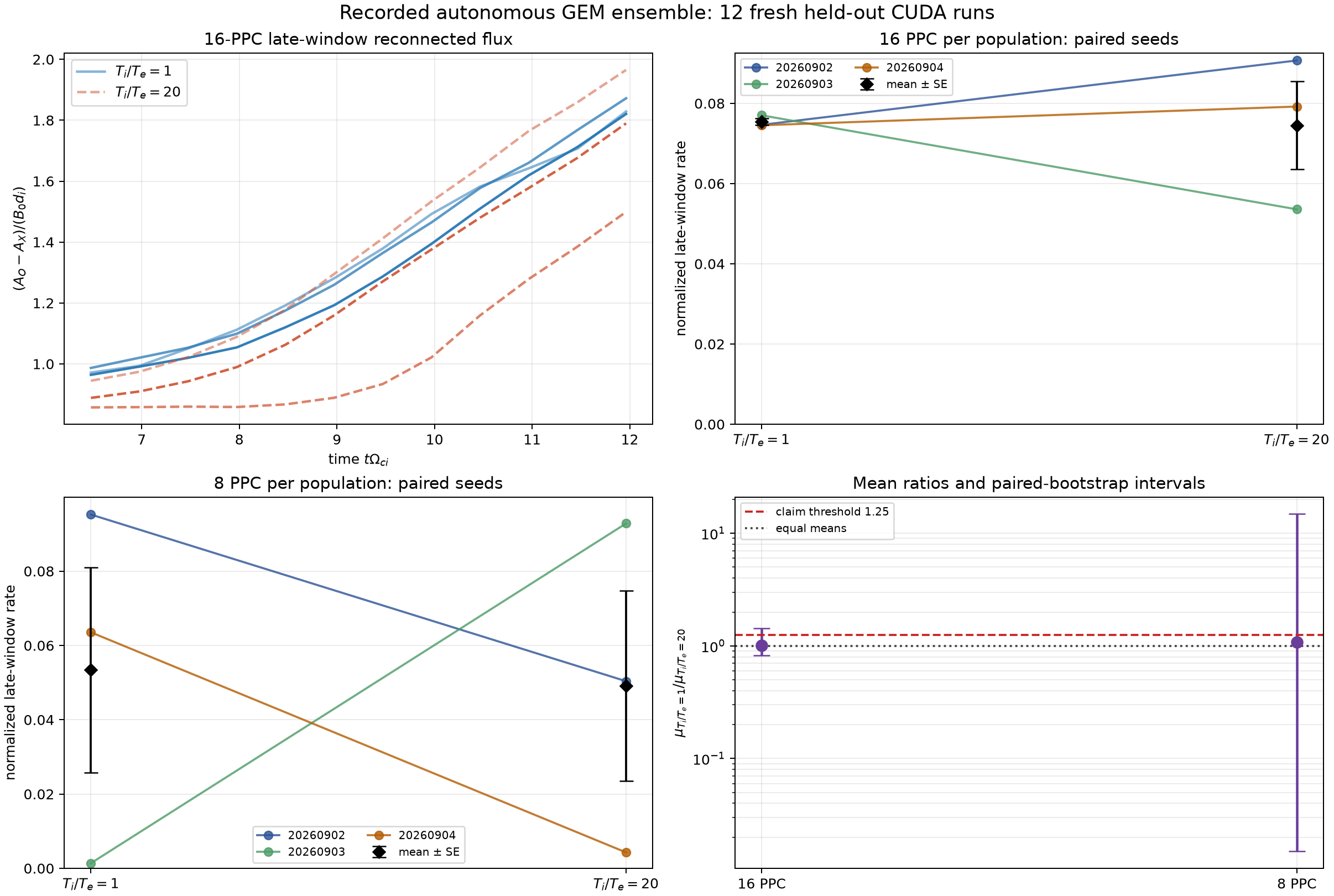
The complete fresh ensemble. The proposed endpoint-ratio threshold was 1.25.
Recorded result
At 16 particles per cell per population, the endpoint means were approximately 0.07541 and 0.07450, giving \(R_{16}=1.0122\). At 8 particles per cell they were approximately 0.05339 and 0.04917, giving \(R_8=1.0858\).
The frozen point-estimate rule marked the operational child claim falsified because all groups were valid and \(R_{16}<1.25\). The paired three-seed bootstrap interval for \(R_{16}\) was \([0.823,1.437]\), however, and therefore still included the proposed population threshold. The lower-particle control was highly seed-sensitive.
Audit interpretation
The campaign ran nominally and produced a legitimate finite-sample protocol outcome. Its terminal prose strengthened that outcome into a population-level falsification and described the particle-count control too confidently. Those are plausible scientific-judgment errors rather than missing computation or fabricated evidence.
The ledger preserved the operational child’s contracted falsification while the immutable root remained open. The defensible external interpretation is:
The observed sample means do not show a 25 percent enhancement. The specified point-estimate protocol falsified its operational child, while the population root remains unresolved with three seeds.
The recorded demo includes the complete top-level audit files, all 12 scientific summaries, frozen analysis programs, commissioning fixtures, two representative final-field archives, and a verifier. Its provenance inventory records all 482 files and 893,147,359 bytes from the original workspace. The bulk raw openPMD histories remain outside Git and still need an external archive with a permanent identifier.