Magnetic-island coalescence with FLASH
Can one resolved reconnection-rate scaling describe a resistive-MHD island coalescence model across its declared resistivity range? This plasma example connects a real FLASH simulation, field diagnostics, numerical qualification and an autonomous attempt to test a scaling hypothesis.
Read the plasma fields
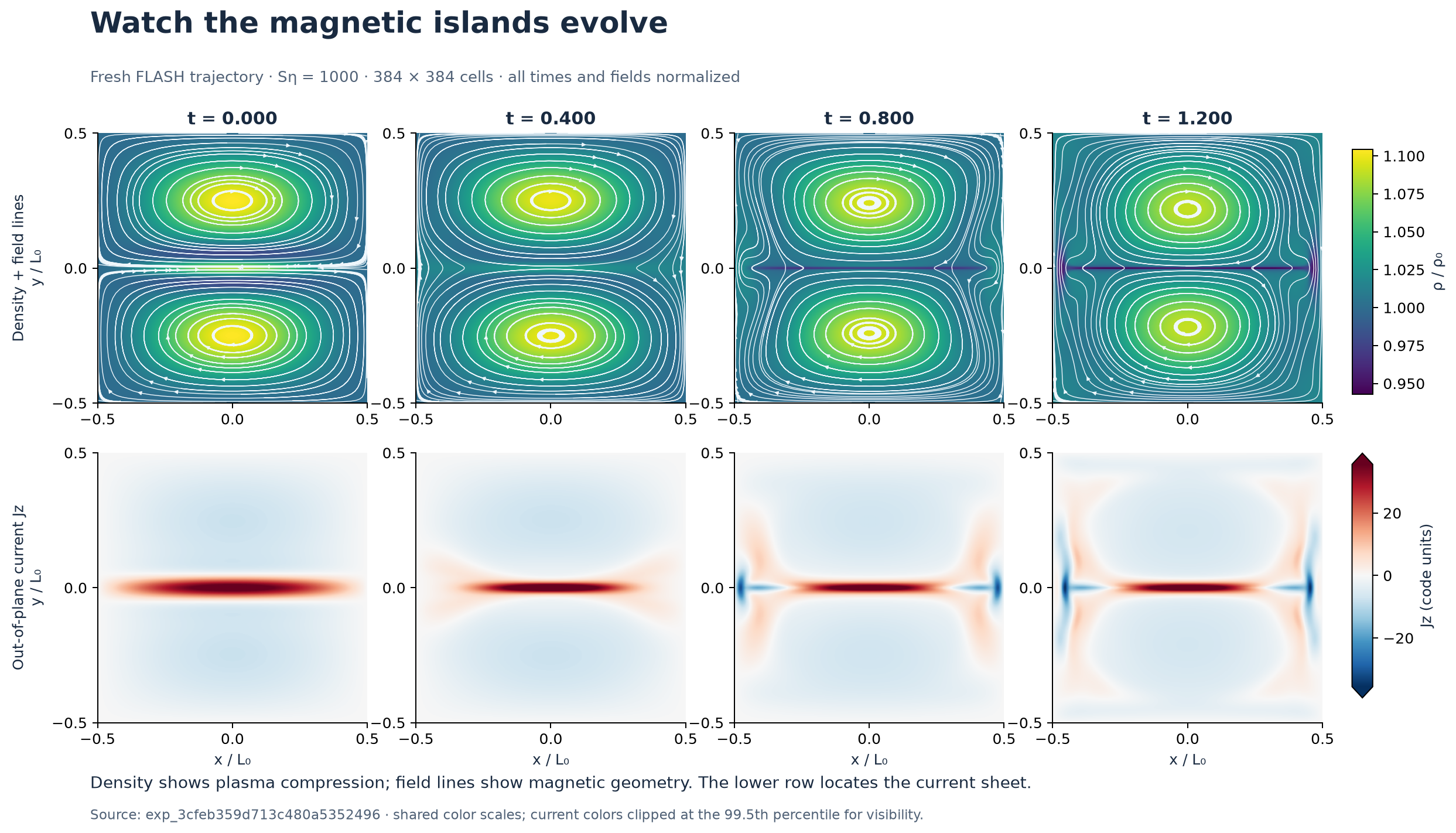
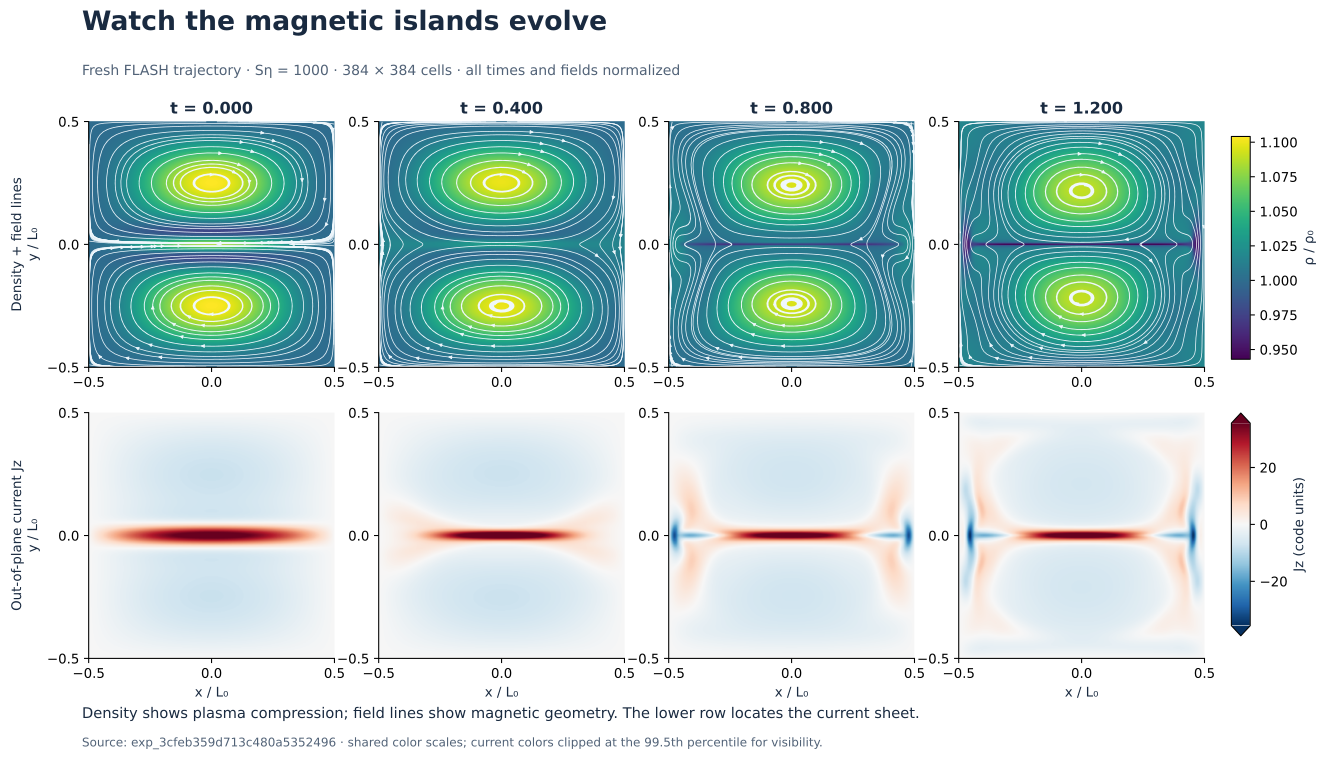
The upper row shows density with magnetic field lines; the lower row shows the out-of-plane current. Follow the central current sheet across the four actual output times. Each row uses a shared color scale. These fields come from the fresh \(S_\eta=1000\), \(384^2\) refinement run—not the older commissioning example. Download PDF · Open SVG.
Follow the evidence
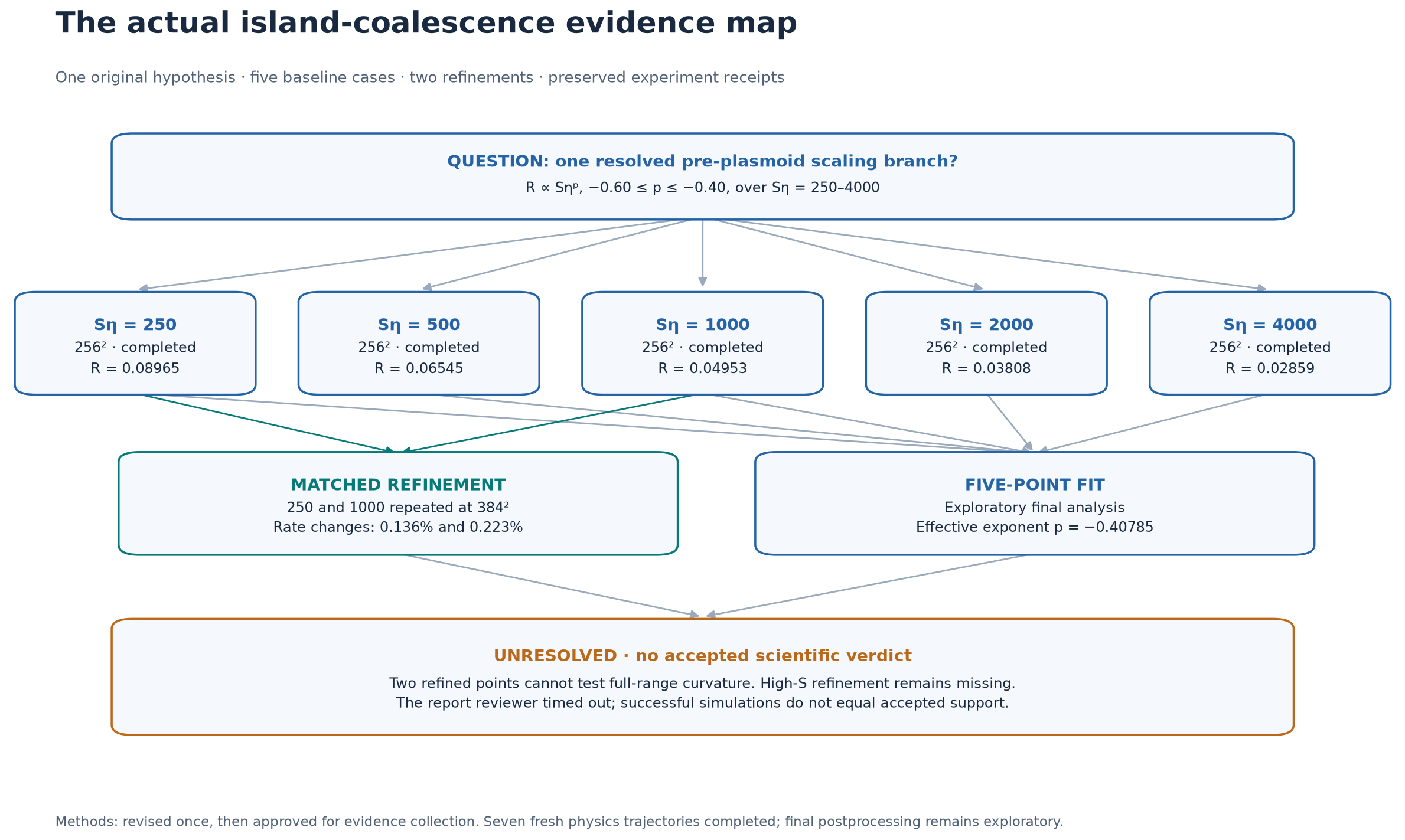
The 30-minute continuation completed all five \(256^2\) baseline cases and both planned \(384^2\) refinements. The rate changes under refinement were 0.136% at \(S_\eta=250\) and 0.223% at \(S_\eta=1000\). The two-point endpoint exponents were −0.42793 and −0.42730. Those matched points are consistent with the stated band; they do not establish its persistence across the full range.
The five-point base-grid fit gave −0.40785, with slight curvature that did not fit the chosen 1% error boxes. Only two common refined points were available, so the curvature test could not be repeated on the refined grid. The original hypothesis remains unresolved. No repair claim was accepted.
The map summarizes actual experiment receipts and relationships. It is an editorial evidence map; the formal claim graph still contains the open original claim. Method approval permits evidence collection and is separate from claim approval. Final postprocessing was recorded as exploration after a changed-input binding blocked its evidence-stage submission. The report reviewer timed out, so the original narrative remains unreviewed, including its stale pending-analysis passage. The quantities above are read from the completed analysis receipt. Download evidence-map PDF.
Follow a figure or result |
Original record |
|---|---|
Fresh \(384^2\) field trajectory |
|
Rates, fits, uncertainty and coverage |
|
Figure arrays and source hashes |
|
Report review outcome |
The continuation retained the original question, GPT-6.1 Sol medium worker and Sol high reviewer. The operator supplied no suggested scientific interpretation. Its numerical cutoff preserved the final 7.5 minutes for reporting; subsequent report-scheduling repairs are documented in the demo audit.
The physical question
The bounded model is two-dimensional, compressible, single-fluid resistive MHD with uniform resistivity. The root claim proposes a pre-plasmoid branch
that persists under spatial refinement. Here \(S_\eta\) is the normalized inverse-resistivity control used by this setup, not a dimensional Lundquist number. The rate diagnostic, flux window, sheet resolution and branch eligibility must be established before interpreting a fit. This single-fluid model does not resolve electron-scale kinetic reconnection.
The classic campaign remains available
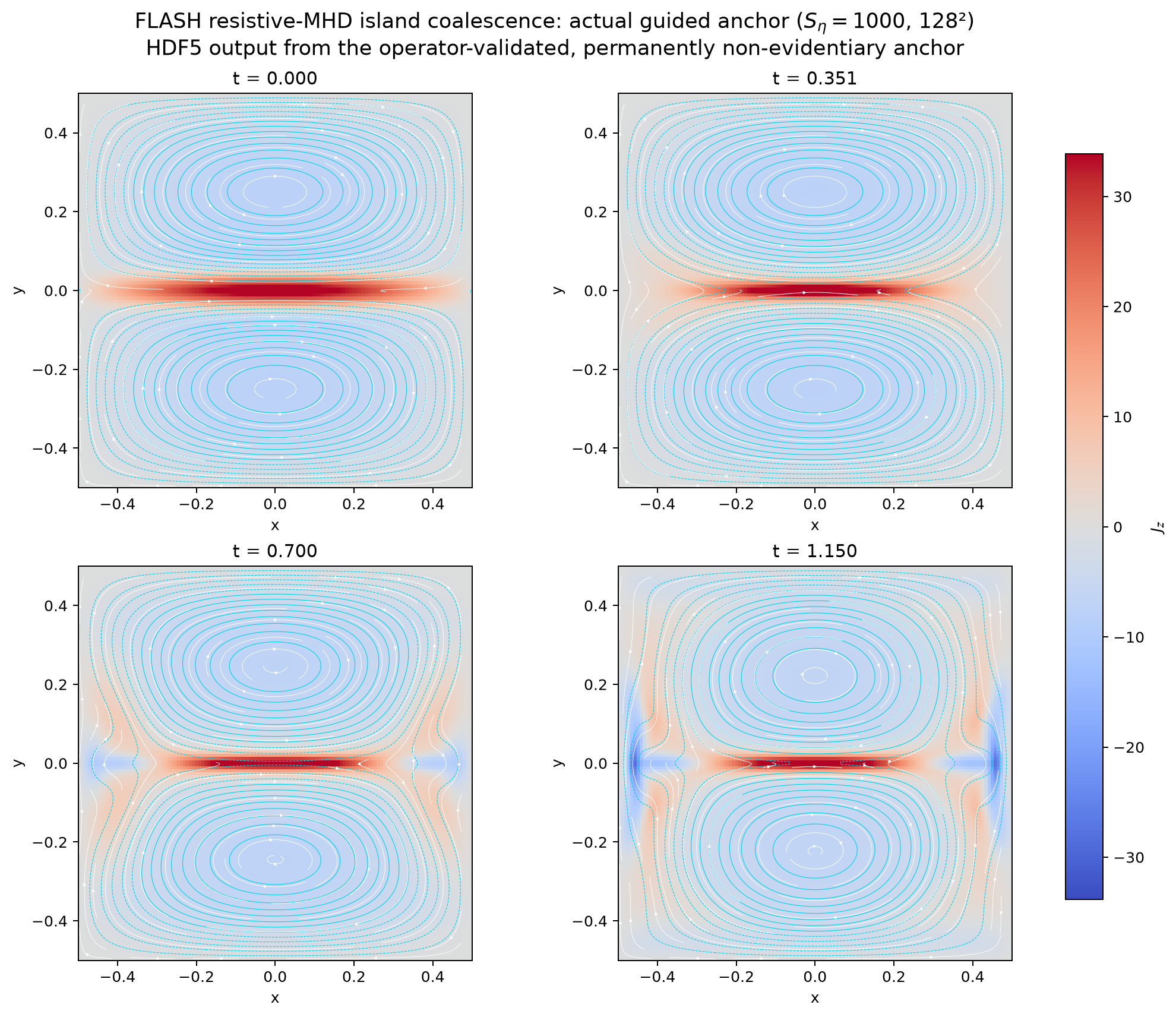
Preserved commissioning run: 2D FLASH 4.8, 128 × 128 cells, four MPI ranks, uniform resistivity. These are actual computed fields. The commissioning run establishes a working instrument; it is not evidence for a scaling law.
The original demo retains the guided input, plotting code, field and profile figures, a real GUI capture and the six-hour campaign’s audit extract. No original figure or record has been replaced by the refreshed documentation.
That campaign recorded the root as falsified and left its repair open. The later audit identified an important interpretation error: the root’s reported 95% interval, \([-0.423266,-0.389641]\), overlaps the proposed exponent band. An upper edge above \(-0.40\) does not, by itself, reject the whole band. The repair also missed its specified refinement case and failed final analysis-lineage checks. Read the original record together with its appended correction.
This is a useful example of why a convincing field plot, a regression and a recorded verdict need to be assessed separately. The historical audit extract is not a portable, completed scientific evidence package.
The fresh one-hour minimal run
The refreshed study ended unresolved at its one-hour cutoff. It did not establish a new reconnection-rate scaling. It used the same original physical hypothesis and FLASH executable, with GPT-6 Luna at medium effort as worker and GPT-6.1 Sol at high effort in the separate review context.
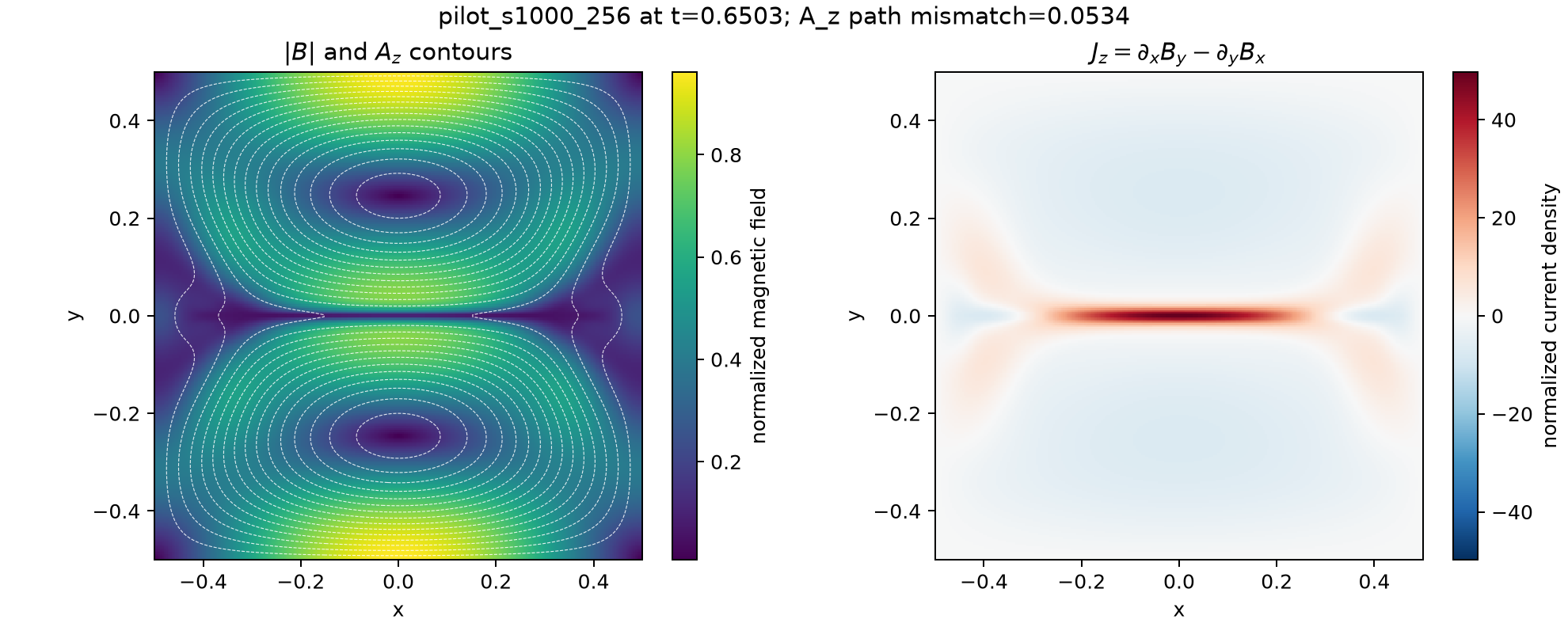
Fresh \(256^2\) commissioning trajectory at \(t=0.6503\), rendered by the agent from its recorded fields. The picture is exploratory; it is not accepted evidence for the scaling hypothesis. Its title retains the original path-error diagnostic; see the post-run correction below. The earlier field figures above remain unchanged.
The reviewer requested three rounds of methods revisions before approving a production method. It identified gauge-sensitive topology/flux diagnostics, incomplete-measurement handling, uncertainty propagation and the rule for comparing refinement results. The worker preserved those decisions and revised its sources; approval of a method did not establish the physical claim.
Production approval arrived 46 minutes into the 60-minute budget, leaving about 14 minutes for final evidence collection and review. The classic campaign had six hours and a different model/backend; these records do not isolate a workflow or model advantage under matched conditions.
Part of the record |
Observed outcome |
|---|---|
Recorded executions |
25 succeeded, 5 failed, 1 was cancelled; these include analysis and qualification jobs as well as simulations |
Fresh complete evidence trajectories |
\(S_\eta=250\) at \(96^2\) and \(120^2\); \(S_\eta=1000\) at \(128^2\) and \(160^2\) |
Diagnostic eligibility |
The four complete cases failed the declared flux-potential path-consistency screen |
Low-resistivity endpoint |
\(S_\eta=4000\), \(256^2\): cancelled after partial evolution; it had not reached the full measurement window |
Scaling and refinement verdict |
No eligible fresh scaling dataset; no scientific claim accepted |
The larger \(S_\eta=1000\), \(256^2\) pilot passed the local diagnostic screen, but it was commissioning/exploration. It could not be relabelled as fresh claim evidence. The incomplete \(S_\eta=4000\) trajectory was censored, not treated as a physical counterexample. Much of the budget went into diagnostic development and review; the final record does not distinguish the exponent band with qualified data.
The campaign’s ineligibility decisions are preserved, but a subsequent operator check identified a defect in the diagnostic itself, described below. The rejected cases should not be interpreted as evidence that FLASH failed to resolve the field.
Post-run correction: a half-cell error in the diagnostic
The agent’s two-path check mixed a cell-centre gauge with an integration starting at the lower cell boundary. Its vertical path included an extra half-cell contribution. The horizontal path used the first cell-centre row, so the two paths did not represent the same coordinates. The worker’s qualification fixture and independent methods review missed the error.
The reviewer had identified earlier gauge and path-alignment defects and requested corrections, including a fixture with nonzero \(B_x\). The final repair still contained the half-cell mistake, and its fixture accepted discrepancies below 0.15 rather than establishing agreement with the exact potential. The review caught useful problems but did not verify that this repair was correct.
A separate post-run calculation applied consistent quadrature to the same retained fields. It compares the average potential on the two central cell-centre rows along both paths; it is not an exact continuum evaluation at \(y=0\).
Case |
Original maximum discrepancy |
Consistent-coordinate discrepancy |
|---|---|---|
\(S_\eta=250\), \(96^2\) |
0.248636 |
\(1.98\times10^{-7}\) |
\(S_\eta=250\), \(120^2\) |
0.217575 |
\(1.37\times10^{-7}\) |
\(S_\eta=1000\), \(128^2\) |
0.202556 |
\(1.86\times10^{-7}\) |
\(S_\eta=1000\), \(160^2\) |
0.177381 |
\(1.50\times10^{-7}\) |
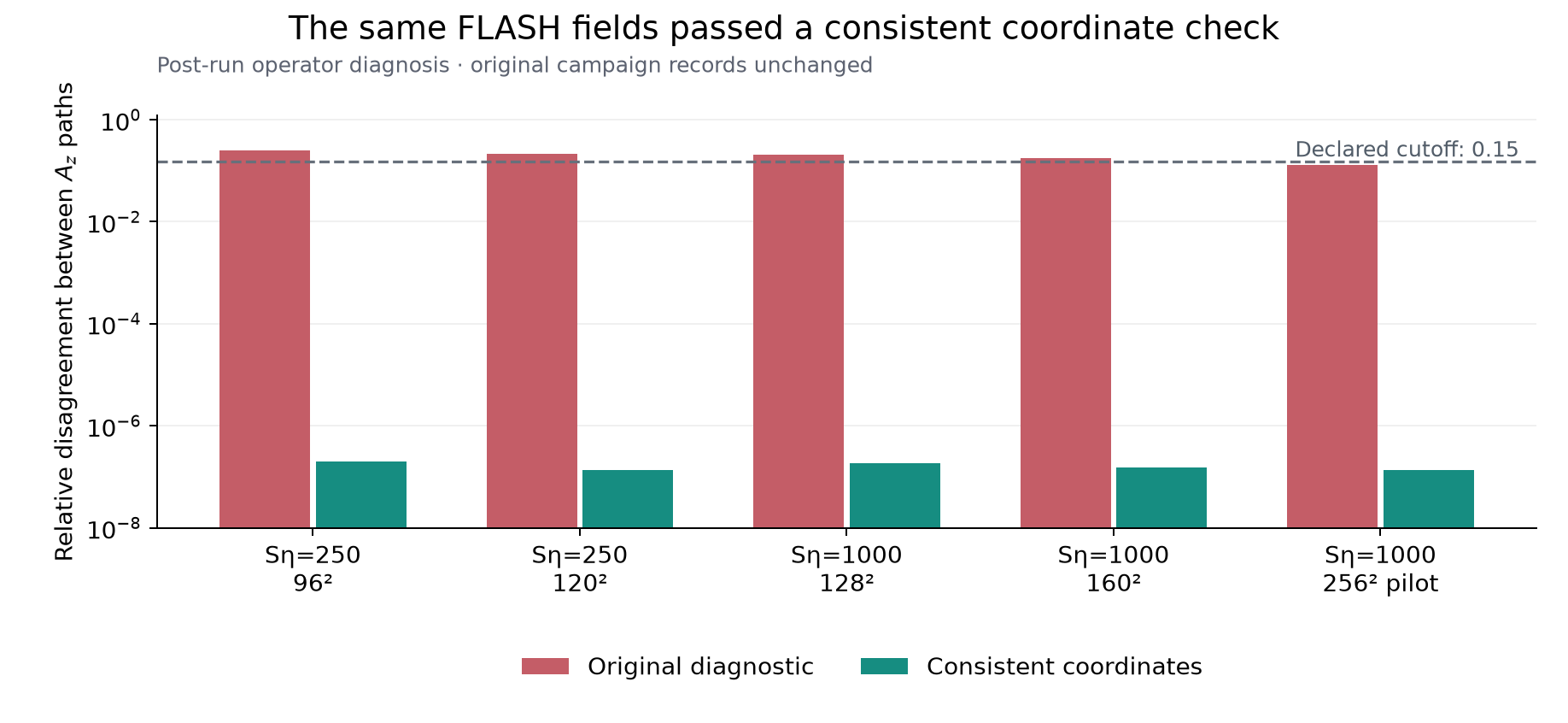
An independent analytic field, \(A_z=x(y^2+0.005)\), exposes the same problem: the original formula reports a discrepancy of about 1.04 on a \(96^2\) grid, while the corrected paths match the exact row-average potential to roundoff. The regression tests include unequal cell spacings and a shifted coordinate origin.
This correction explains the false path-screen rejections. It does not supply the missing resistivity coverage, certify the remaining diagnostics, or create an accepted scaling claim. The original sources, receipts, methods decisions and report remain unchanged. The new check is explicitly operator-authored, after termination; it is not attributed to the autonomous worker.
Run the analytic check without a solver, raw FLASH files or a model call:
uv run python demos/resistive_mhd_island_coalescence/postrun_coordinate_check.py
The check report and source
retain archive hashes and the five-case numerical comparison, including the
commissioning pilot. Rechecking those raw fields requires the original local
archives via --study PATH; the compact Git extract does not include them.
This is a concrete contribution opportunity: validated coordinate-aware diagnostics
can prevent an agent and its reviewer from repeatedly reasoning over a flawed test.
Inspect the audit
The minimal-run extract contains all execution receipts, methods decisions, director records, retained source and compact outputs. It preserves the original worker report without rewriting its conclusion. Bulk FLASH histories and native provider sessions are omitted, with declared-file hashes recorded; this is a compact audit rather than a complete numerical replay package.
uv run python demos/resistive_mhd_island_coalescence/verify_minimal_record.py
This checks retained-file integrity and recorded dispositions, without FLASH or a model call. It does not independently reanalyse the omitted HDF5 histories. The completed Kepler investigation provides a smaller record with full retained arrays and a no-key numerical reproduction path.
The exact source commit was 09ddd7a51387124b5e2ed38d254f76b601f9aa11, a development
checkout based on 0.6.0 with the ancestor-review scheduling fix. The manifest fixes
that identity independently of future releases. Reported native counters totalled
57,726,924 input tokens, including 56,304,384 cached tokens, and 240,213 output
tokens. Ten turns have incomplete usage reporting; these counters are not an
invoice. A separate CUDA compilation overlapped part of the run, so its wall time
is not a controlled comparison with another model or campaign.
A second one-hour run with Sol as worker
An operator-requested follow-up used GPT-6.1 Sol at medium effort as worker, with Sol at high effort in the separate review context. The hypothesis, original instructions, requirements, commissioning files and FLASH runtime identity were unchanged. The post-run coordinate correction was not supplied to this worker. The research service and supervisor matched the Luna run; a separate web run-discovery fix was applied during monitoring.
This run reached a much broader numerical dataset, but also ended at the cutoff without an accepted scientific verdict:
Work |
Recorded result |
|---|---|
Baseline scan |
Five completed \(256^2\) evidence trajectories at \(S_\eta=250,500,1000,2000,4000\) |
Refinement |
Completed \(384^2\) runs at 250 and 1000; preserved 4000 output contains the full measurement window despite a later timeout |
Recovery |
Independent methods review approved hash-bound postprocessing of the timed-out evidence run; the timeout receipt remains unchanged |
Recorded executions |
18 succeeded, 5 failed, 1 cancelled, including qualification and analysis jobs |
Final analysis |
Four baseline cases and three matched refinement cases passed its implemented eligibility screens; the 500 case failed the cadence-decimated window check |
Scientific review |
No claim review was recorded before the wall cutoff |
The final processing reports a four-case baseline exponent of approximately \(-0.4111\) and a three-case refined exponent of \(-0.4126\). Their residual-based 95% intervals overlap the proposed exponent band. A separate joint power-law feasibility calculation flags curvature under the agent’s empirical error boxes; that is an unreviewed result, not an accepted physical falsification.
The workflow still lost time at the analysis boundary. Campaign plotting tried to import Matplotlib inside the FLASH runtime, where it was unavailable. The worker replaced that rendering with SVG, but the changed source/binding and final exploratory analysis were not approved for decisive processing before termination. Its report also contains stale intermediate statuses; the receipts and final host disposition are authoritative.
The 212-file compact audit preserves the original sources, outputs, figures and reviews. It includes the successful diagnostic recovery as exploration, without promoting it to a new evidence receipt. Bulk fields and native provider streams are omitted.
uv run python scripts/verify_research_audit.py \
  demos/resistive_mhd_island_coalescence/sol_medium_record
Reported native counters totalled 8,903,040 input tokens, including 8,186,624 cached tokens, and 63,788 output tokens; four turns have incomplete usage reporting. Compared with the Luna record, this run produced more simulation coverage and used fewer reported tokens. Both remain unresolved. The runs shared this machine with different concurrent work and each model was sampled once, so this is an observed case comparison rather than a controlled model ranking.
Reproduce the instrument or contribute a stronger test
The original demo provides the exact commissioning command and plotting script. FLASH source and binaries are supplied by the operator under their upstream license; they are not distributed with this repository. A fresh study must commission the executable through its actual experiment launcher and retain its own inputs, diagnostics and evidence.
To start a separate minimal-mode study from a source checkout, point
--capabilities to the directory containing your qualified island-coalescence
capability. Select your worker and reviewer models; the recorded one-hour run
used the routes shown here:
uv run simjecture study \
  --campaign artifacts/my-island-minimal \
  --hypothesis-file demos/resistive_mhd_island_coalescence/hypothesis.txt \
  --instructions-file demos/resistive_mhd_island_coalescence/minimal_instructions.txt \
  --requirements-file demos/resistive_mhd_island_coalescence/minimal_requirements.json \
  --guided-commission demos/resistive_mhd_island_coalescence/guided_commission.json \
  --capabilities /path/to/qualified/capabilities \
  --backend codex --model gpt-6-luna --reasoning-effort medium \
  --judge-model gpt-6.1-sol --judge-reasoning-effort high \
  --mode minimal --completion-policy repair --wall-seconds 3600 --director
A new campaign consumes model usage and produces new evidence; its transcript and outcome need not match the recorded study. Its budget must include diagnostic qualification, numerical controls and review, as well as solver execution.
Useful extensions include a justified rate diagnostic, spatial/time convergence, branch qualification and a clearer test of the proposed scaling interval. Start with guided commissioning and the evidence rules.