The autonomous research loop
You bring a scientific question, a starting hypothesis and the conditions under which an answer would matter. Simjecture gives an agent a bounded period in which to investigate it, while keeping an inspectable connection between each claim, the experiments behind it and the decisions made in review.
1. Agree on the question
Start in a conversation. Supply the physical model, relevant observations or paper, available instruments and a time budget. The agent can help turn these into a testable statement. Review the study brief before launching; the original question and operator requirements become part of the record.
A useful hypothesis predicts a measurable outcome in a stated domain. For example, “energy error below this threshold implies position error below that threshold over twenty orbits” specifies an implication that an experiment can challenge. “Study orbital dynamics” leaves the success criterion open.
2. Let the agent choose the experiments
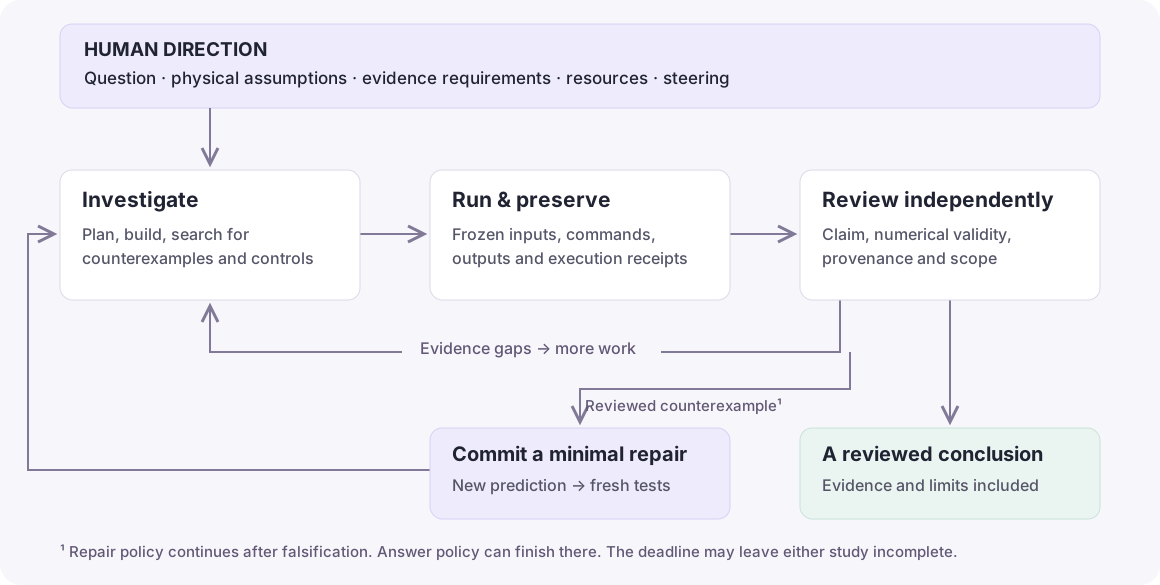
In the default minimal mode, the worker chooses its plan, writes code, uses its native tools and selects which numerical experiments to run next. It can develop diagnostics, commission an instrument and explore alternatives. A research director can check whether its strategy is still useful and affordable, and request a recorded replan.
The worker submits decisive computations through the experiment service. Each submission preserves the source and declared inputs, command, runtime identity, execution outcome and output hashes. You can follow active jobs and open the actual files from the study.
3. Search for a counterexample
A successful simulation tells you that a computation ran. The scientific question is whether its result challenges or supports the stated prediction. A candidate counterexample needs the relevant controls: units, reference calculations, numerical resolution, model assumptions and uncertainty.
For a supported claim, the reviewer requires evidence of an active challenge. Boundary cases, failure-prone regimes or an exhaustive finite test can be useful. The worker explains which tests challenged the claim and what happened.
4. Repair a falsified hypothesis
With the Seek a supported claim or tested repair completion policy, an accepted counterexample starts another scientific step. The agent proposes a replacement, explains the smallest justified change and preserves the parent claim and its counterexample.
Before testing that replacement, it commits its statement, acceptance rule and exact planned computations. Fresh experiments then test those predictions. The system checks source and command identity and that the committed cases were run; the reviewer judges whether the repair explains the failure and is scientifically meaningful. Further counterexamples can produce further branches.
The Answer the question policy also permits a reviewed falsification of the original claim to finish the study. New browser studies default to this policy; the headless CLI defaults to the repair policy. The hosted public trial currently uses answer policy; use a local workspace or CLI study for the full repair loop. Choose deliberately when preparing the brief. Research mode and completion policy are separate settings.
5. Review the evidence independently
A separate agent context examines the target claim, frozen source, results, controls, counterexample search and, for a repair, its ancestry and prospective commitment. It can accept support or falsification, or return specific evidence gaps. Gaps send the worker back to investigation while time remains.
The worker cannot approve its own claim through the research API. An independent agent review is still a model judgment; domain experts remain responsible for interpreting physical adequacy and any publication claim. The record makes that judgment inspectable.
Keep human insight in the loop
You can inspect intermediate results and send guidance at a checkpoint: consider a neglected mechanism, compare against a paper, or seek a cheaper complete calculation. The original claim and requirements stay fixed within the phase. Changing them or adding time creates a linked continuation with selected prior files and an explicit new brief.
At the deadline, incomplete work remains incomplete. A normal model exit, a failed solver or an attractive plot does not constitute a reviewed answer. Partial work can still inform the next phase.
What you take away
A scientific narrative linked to experiments and reviews.
The original hypothesis and any committed replacements, with their relationships.
Frozen experimental inputs and recorded outputs, including failures and interruptions.
Review decisions, missing evidence, steering and strategy changes.
Reported model usage and execution costs, with missing measurements identified.
Read the evidence system, follow the first investigation, or inspect a recorded example.