FuZE mesh refinement and solver diagnostics
Where should a limited cell budget go, and how can we tell whether a solver change improves a plasma calculation? LCB119’s local experiments explored these questions with FLASH gas loading and native WarpX development.
The FLASH branch placed 199,800 cells in five prescribed refinement levels and advanced gas loading to 43.22 µs. The WarpX branch established a short RNG-aware restart comparison, then used the same starting stochastic state to test an axis-boundary candidate. That candidate still produced near-axis transients and was not adopted as a repair.
Record type: operator-assisted exploratory host development, using the installed Simjecture 0.7.0 workspace. This retrospective snapshot was exported on 4 November 2026. It has no formal harness-adjudicated scientific verdict. The FLASH and WarpX results below belong to separate branches, not a coupled run.
What you can verify: the retained files and reported arithmetic, using the command below. Raw simulation outputs and local solver modifications are omitted, so this checkout does not support a solver rerun or independent field reanalysis.
Place refinement where geometry needs it
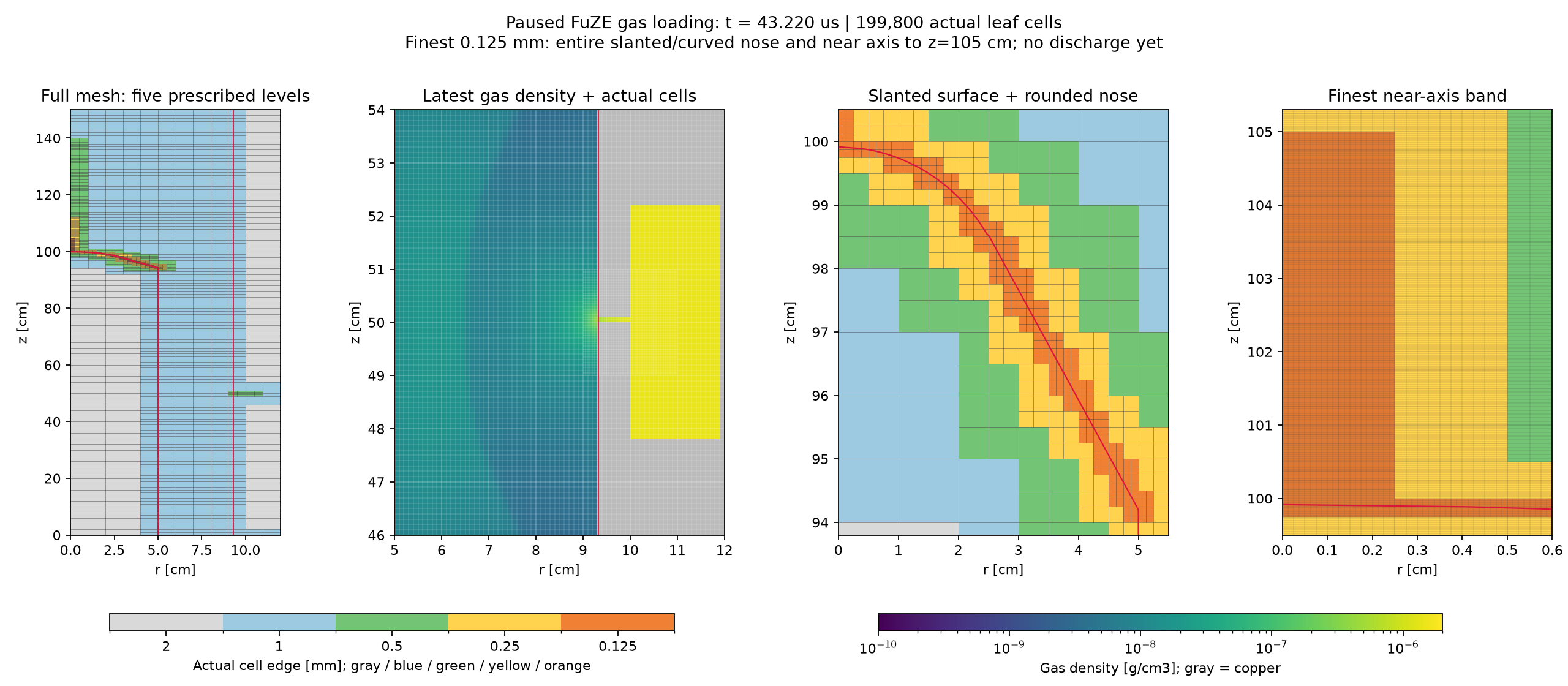
Open the full-size mesh and density figure.
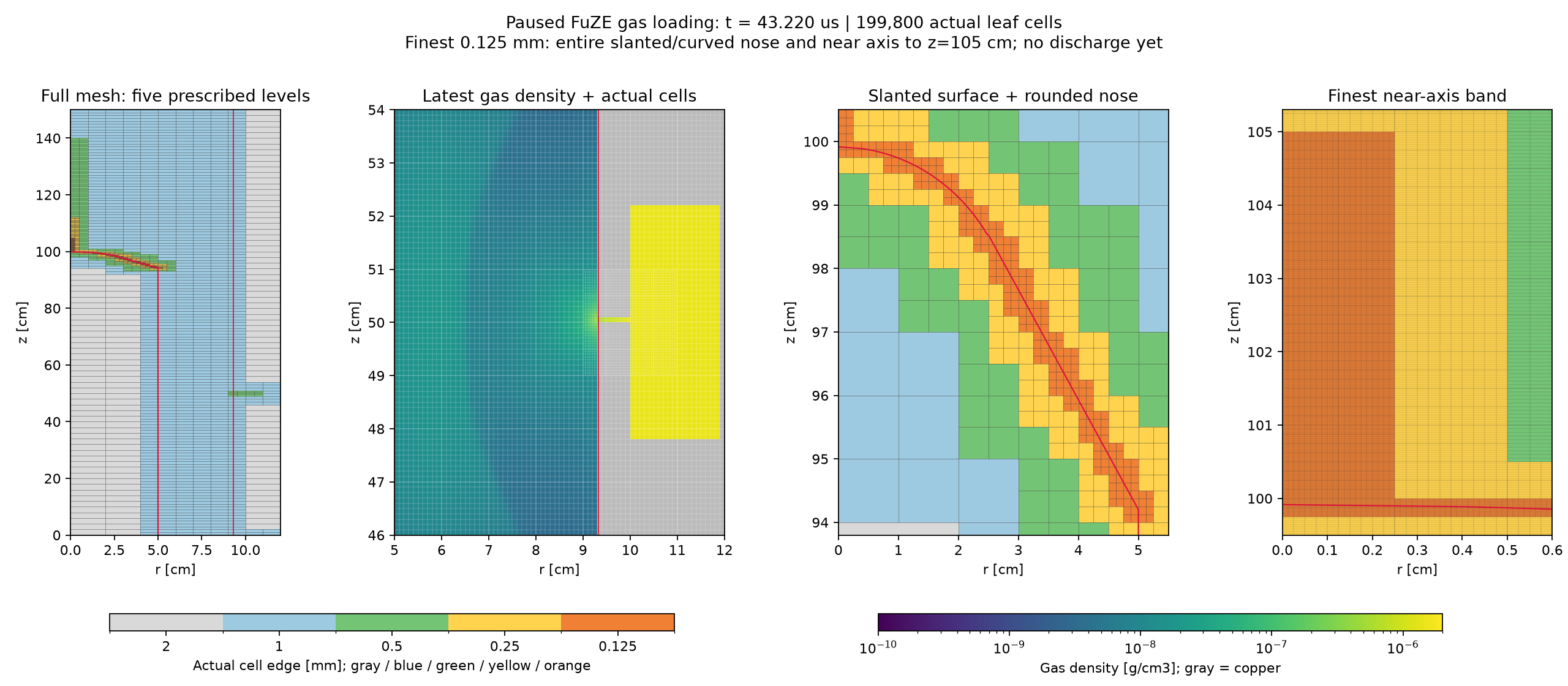
The final V5 layout preserves the cylindrical domain, \(r=0\)–12 cm and \(z=0\)–150 cm. The finest band follows the full slanted/rounded inner-electrode surface and the near-axis region through \(z=105\) cm. Deeper electrode interiors can remain coarse. The gas-port audit reports a discrete width of 1 mm.
Observed level |
Cell edge |
Leaf blocks |
Leaf cells |
|---|---|---|---|
1 |
2 mm |
163 |
16,300 |
2 |
1 mm |
1,075 |
107,500 |
3 |
0.5 mm |
218 |
21,800 |
4 |
0.25 mm |
214 |
21,400 |
5 |
0.125 mm |
328 |
32,800 |
Total |
1,998 |
199,800 |
The archive checkpoint is at 43.2197013177 µs, with finite positive density, electron/ion temperatures and internal energies, and maximum species-sum error about \(3.0\times10^{-10}\). The solver stopped normally and automatic continuation was disabled. The requested loading target was 178 µs; it was not reached.
An earlier same-executable continuation probe redistributed the checkpoint from 8 to 20 MPI ranks and advanced three steps, from 24.762623 to 24.775763 µs. Its recorded thermodynamic checks passed. This is a bounded restart check, not proof that every rank layout or later physical stage is equivalent.
This is prescribed spatial refinement on PARAMESH, not demonstrated dynamic tracking of moving plasma gradients. The picture’s full-device and electrode panels show block boundaries; the density and near-axis panels include actual cell lines. The last forced plot can precede the final checkpoint by one step. Gas loading alone does not qualify nonzero-field transport across coarse/fine interfaces, a discharge, first pinch or secondary breakdown. No such result or mesh-convergence claim is made here.
Make a restarted control comparable
The WarpX work uses a modified native RZ CUDA/PETSc build, with base source
revision 9a685ce598192acde30a0f99f963867ba6441f42, local Hall/QDSMC development
and checkpoint hooks. It is separate from the packaged WarpX 26.07 PICMI
capability. Executable identities are retained for the v7 RNG candidate and
v8 composition with the axis-boundary candidate.
The test asks whether a continuous trajectory and a split trajectory reproduce the same outputs when the split run restores a saved random state. Both use the original physical/numerical settings, including a 0.5 ns timestep.
Control |
Recorded outcome |
|---|---|
RNG feature disabled |
Two original/v2 13-field regressions pass the recorded 1e-10 criterion |
Strict restore from a legacy checkpoint without a snapshot |
Rejected before any physical step |
Continuous 14.55–14.65 µs versus split at 14.60 µs |
Five resumed frames, 13 fields each; maximum relative L2 1.67869e-12 |
Final RNG sidecars |
Identical recorded SHA-256 and byte-comparison result |
Newly injected feed cohort |
400 particles; all seven compared attributes exactly equal |
Deliberately corrupted copied snapshot |
Rejected before any physical step; original checkpoint preserved |
The copied common 14.60 µs anchor is excluded from the five resumed-frame comparison. This avoids counting a copied frame as an independently evolved restart result.
The local candidate saves host RNG and the CUDA state used by ParallelForRNG.
It excludes a private bulk GPU generator, is not a generic portable RNG format,
and cannot reconstruct stochastic history missing from a legacy checkpoint.
These checks establish short-window continuity for this build and path;
they do not establish long-time convergence or a general WarpX restart defect.
Keep a failed repair visible
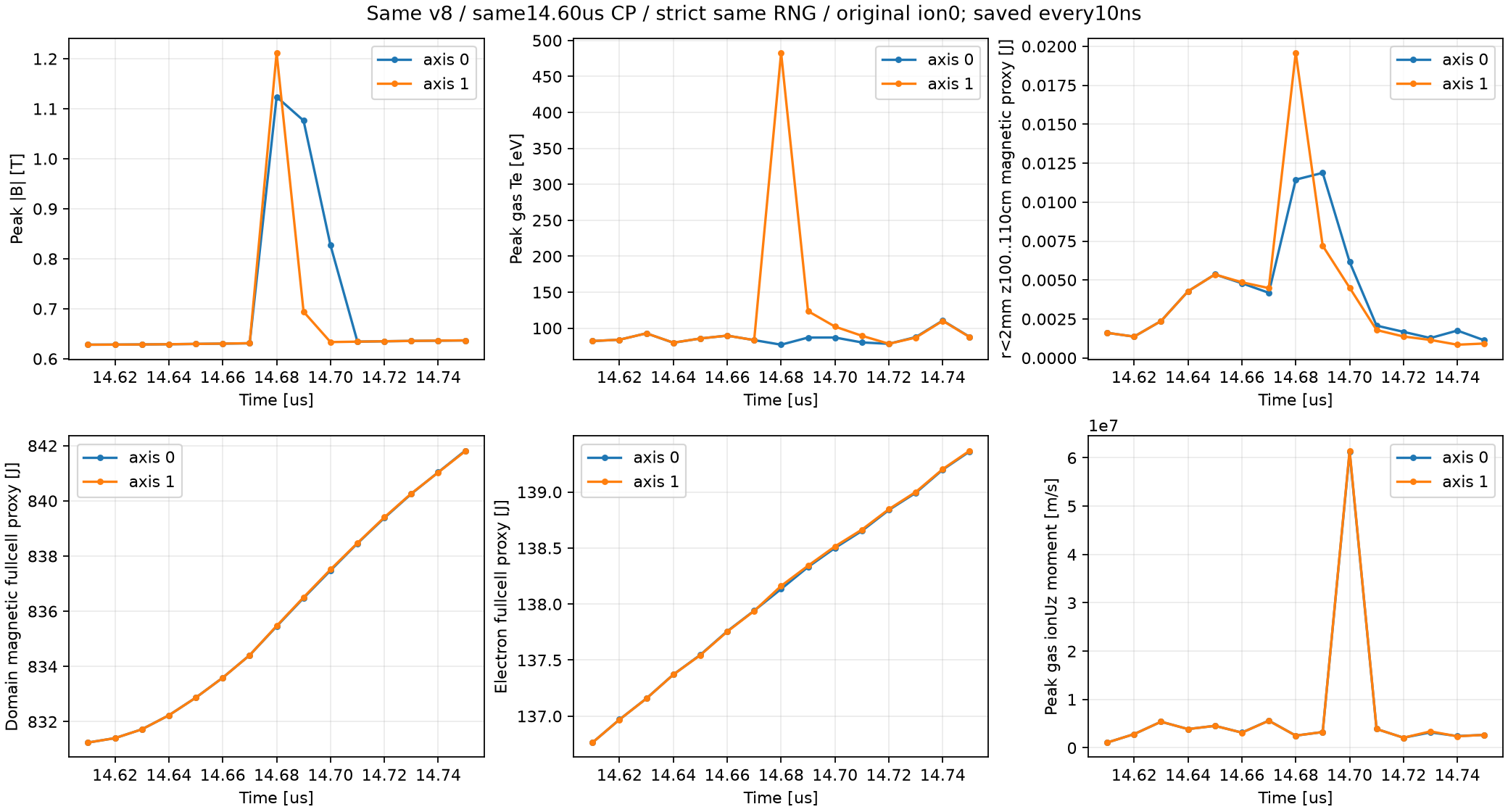
Open the full-size axis-control figure.
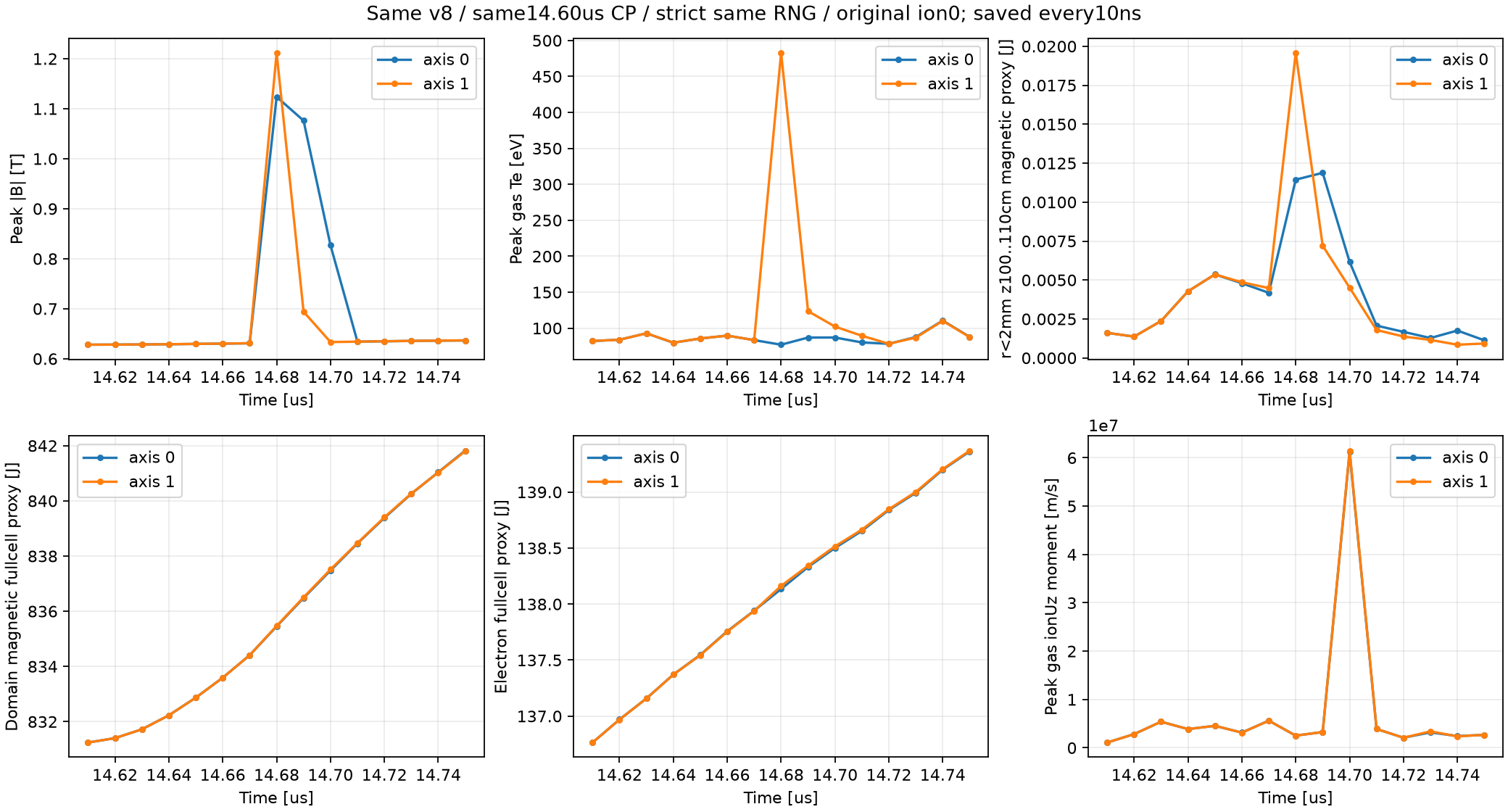
After four two-step composition regressions, the v8 comparison starts both
axis-off and axis-on cases from the same generated 14.60 µs checkpoint,
with the same verified RNG restore before step 29201. Only
hybrid_pic_model.qdsmc_axis_regular_velocity changes. Both complete to
14.75 µs, saving 15 frames each at 10 ns cadence; all 13 saved fields are finite.
The candidate imposes the intended derived-velocity axis regularity, but this does not resolve the observed transient:
Window diagnostic |
Axis off |
Axis on |
|---|---|---|
Peak saved magnetic magnitude |
1.12375 T |
1.21179 T |
Peak saved gas electron temperature |
110.63 eV |
482.86 eV |
Final retained initial-ion count |
1,377,978 |
1,377,979 |
At 14.68 µs the axis-on local magnetic-energy proxy is larger, even though its final local proxy is smaller. A final-frame comparison would hide that spike. Final RNG sidecars match, and the 1,200 newly injected feed particles have exactly matching compared attributes. Different fields nevertheless change particle trajectories and retention: the one-ion difference is recorded, not coerced into identical mass.
Decision: do not adopt the axis-boundary candidate as a repair or resume
production on that basis. Both cases also exhibit large deposited ionUz
moments; these are not individual-particle maximum velocities. No spatial,
particle-number or time convergence, nor experimental fidelity, is established.
The conductivity gate in this branch is externally prescribed. It is not self-consistent neutral ionization. Embedded electrodes do not constitute a resolved copper heating/ablation model. Full-cell magnetic/electron energy proxies omit an exact cut-cell, circuit, particle and boundary-flux ledger; they are not a full conservation proof.
Reuse the diagnostic methods
The reusable contributions live in the existing skills:
FLASH: inspect actual leaf boxes and cell sizes; distinguish prescribed mesh placement from feature tracking; qualify checkpoint redistribution and active version-specific source paths.
WarpX: freeze operator-stage inputs, inspect axis/ghost regularity at the stage actually consumed, and control restart/RNG continuity before interpreting a stochastic on/off comparison.
Experiment-specific mesh placements, thresholds and failed candidates stay in this record. They are not defaults for future scientific studies.
Verify and interpret the public excerpt
python3 demos/fuze_mesh_solver_diagnostics/verify_record.py
This standard-library command verifies seven retained files and recalculates mesh accounting and recorded comparison arithmetic. It needs no solver, licensed source, GPU or API key. The demo README describes the export command, original source hashes and omissions.
Raw fields, particles, checkpoints, local source overlays and solver binaries are not distributed. Consequently the checkout cannot independently recompute the field norms, reproduce the solver runs or validate the physics from raw data. The public excerpt is an inspectable development record, not a turnkey physical reproduction. The exact application Git commit was not retained.
LCB119 provided the scientific framing, operational choices and steering. Agents performed local development, simulations and working-assistant audits; the excerpt and walkthrough are later editorial work. Independent formal scientific acceptance is not claimed.