From a FLASH current sheet to a kinetic WarpX patch
Can a current sheet resolved by an MHD calculation remain nearly isotropic when followed with kinetic particles at ion scales? This two-hour study and its 30-minute continuation link actual FLASH output to WarpX initial conditions, then tests pressure-tensor behavior in a local region.
The transfer and numerical controls ran successfully. The investigation ended unresolved at its cutoff, with no accepted scientific verdict. It demonstrates a working, traceable two-solver investigation and its remaining qualification gaps, rather than a validated general MHD closure.
Follow the actual geometry
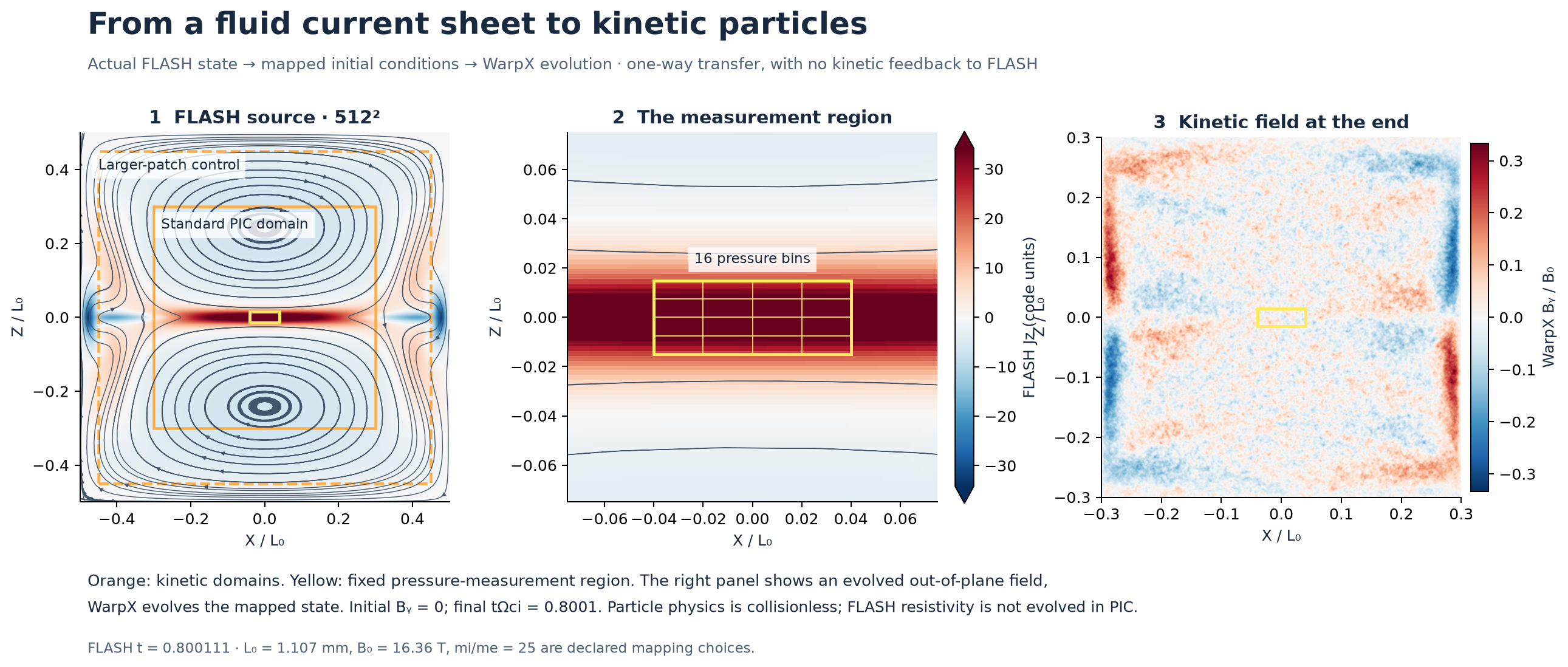
The left panel locates the standard and enlarged kinetic domains in the actual FLASH source. The middle panel enlarges the fixed pressure-measurement region; the grid shows its 16 spatial bins. The right panel shows the out-of-plane field at the end of the fresh WarpX control. Boundary responses are visible near the patch edges; the pressure observable applies to the yellow central region. Download PDF · Open SVG.
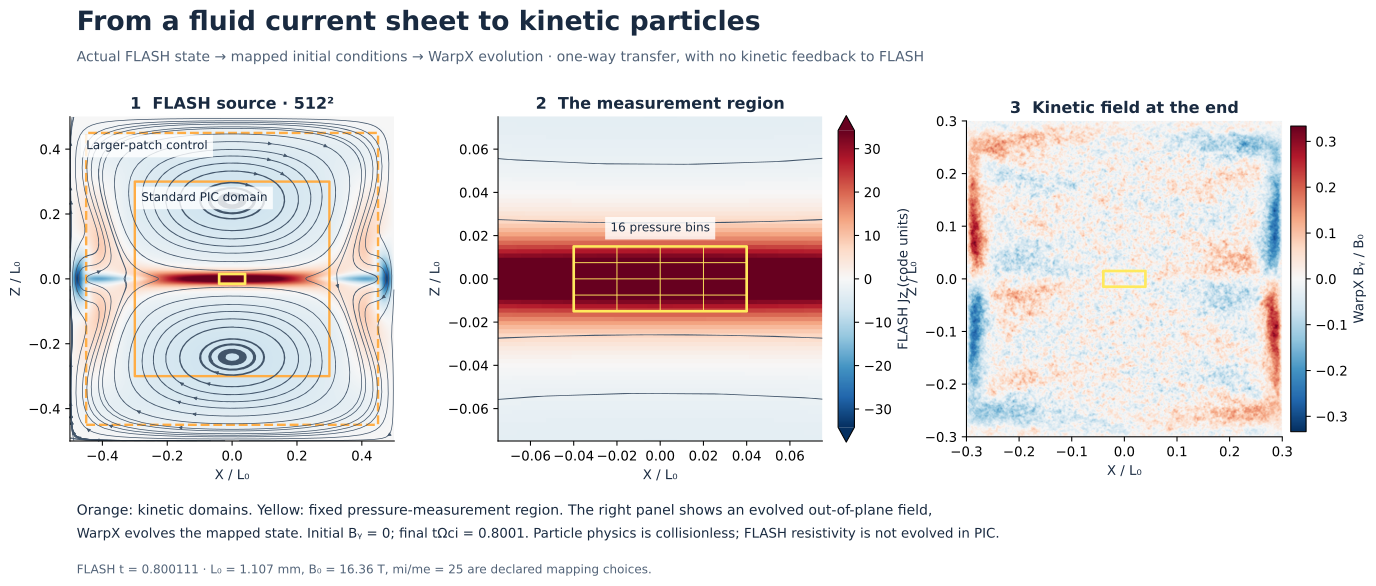
FLASH evolves resistive fluid MHD. The local WarpX problem instead evolves collisionless particles and electromagnetic fields. The handoff preserves a recorded source state and declares the coordinate rotation and dimensional mapping. It is a one-way initial-condition transfer: kinetic fields are not fed back into FLASH.
Look inside the pressure measurement
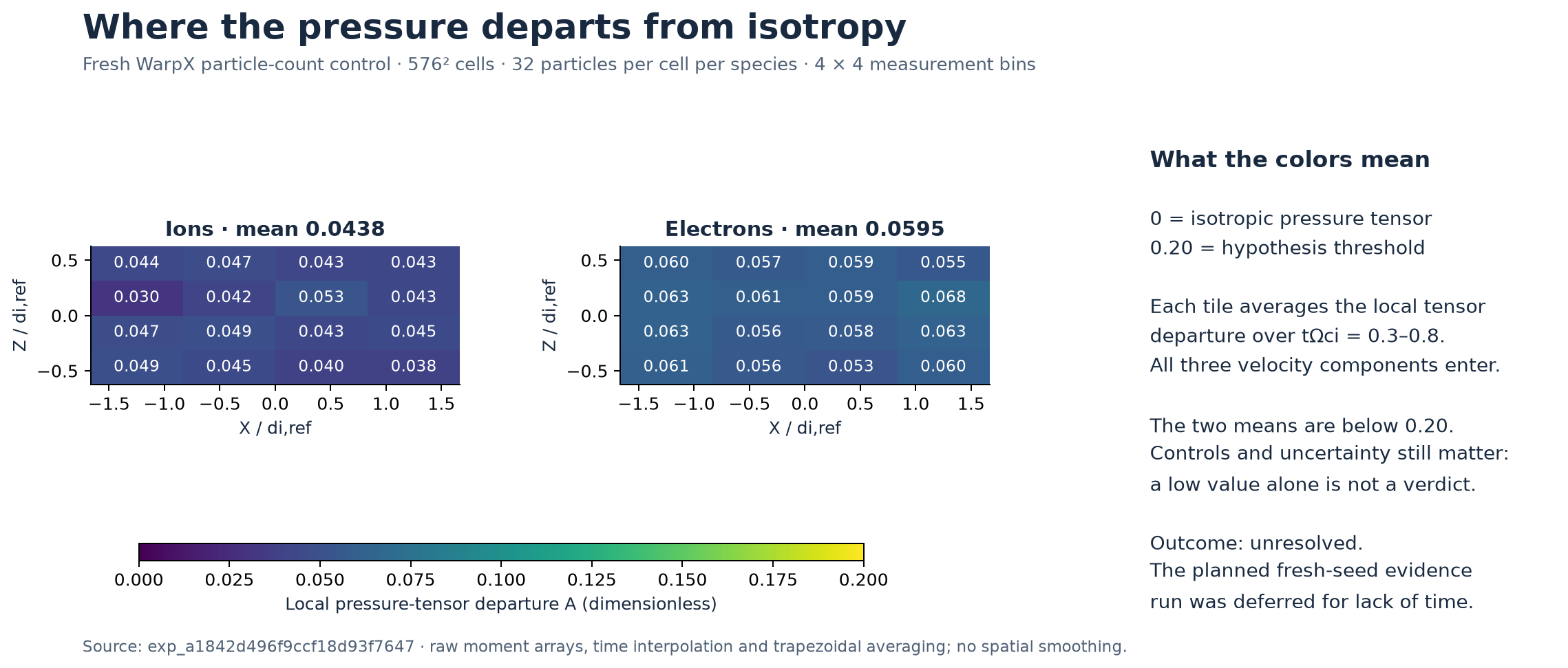
These tiles use the actual particle moments from the fresh \(576^2\), 32-particle control. Each averages the local three-component pressure-tensor departure over \(t\Omega_{ci}=0.3\)–\(0.8\); there is no spatial smoothing. The area/time means are 0.04383 for ions and 0.05955 for electrons, below the hypothesized 0.20 threshold. The color scale retains that threshold so the size of the departure is visible. Download pressure-map PDF.
The new run separates particle-count sensitivity from grid sensitivity. Its matched-grid changes were 0.00411 and 0.00565; its fixed-grid particle-count changes were 0.00319 and 0.00155 for ions and electrons. The recorded control checks pass, but these are commissioning findings. The next prospective fresh-seed evidence run could not fit the remaining compute allowance. The original hypothesis remains unresolved, with no accepted claim verdict.
Follow the evidence and the next test
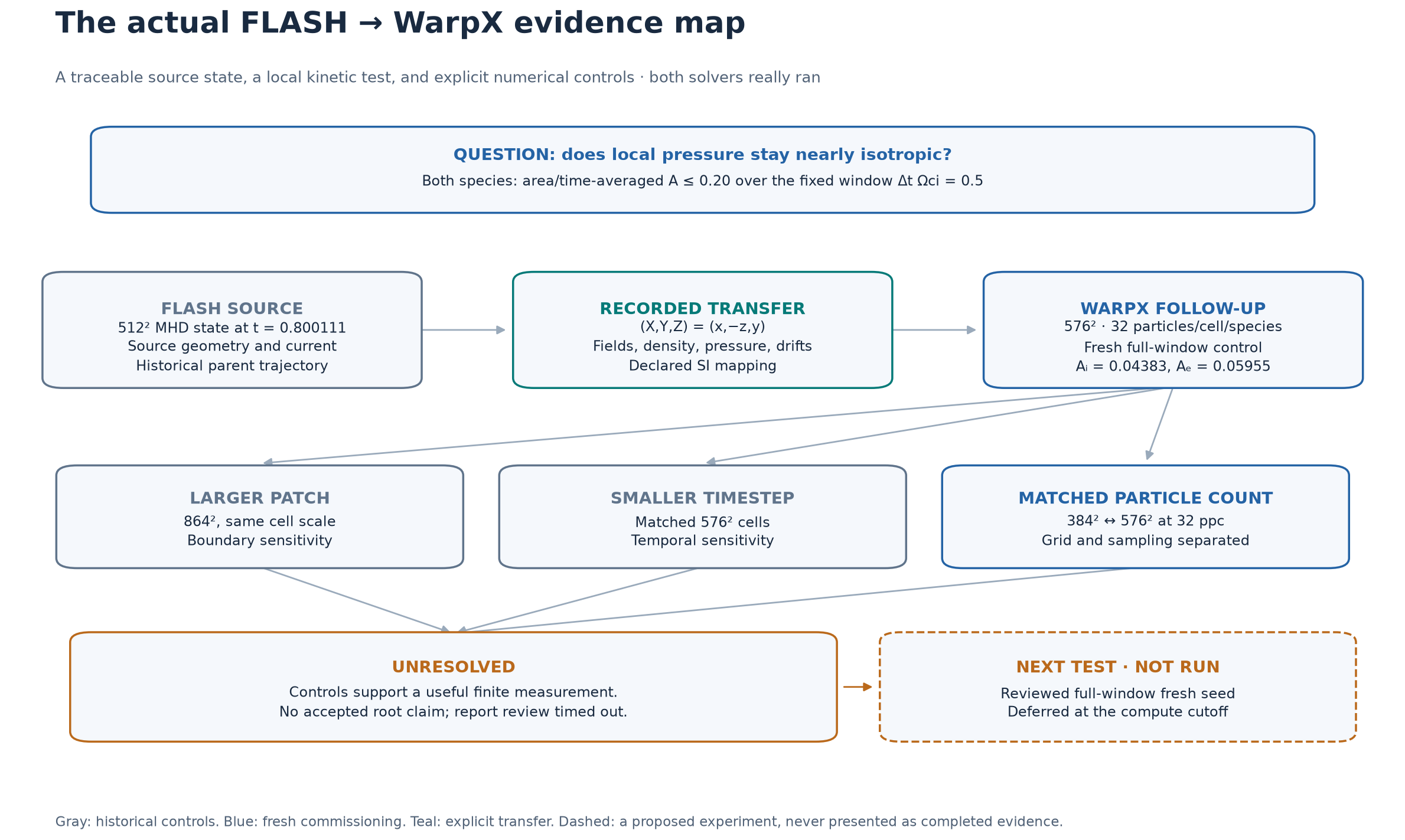
Gray nodes preserve historical parent controls; blue nodes show fresh commissioning. The dashed experiment is explicitly unrun. This map summarizes recorded dependencies; it does not add a supported claim or an invented repair to the formal claim graph. Download evidence-map PDF.
The 30-minute continuation completed five recorded jobs, including the 567-second kinetic trajectory and the combined source/control analysis. Both directors resumed useful worker preparation while simulations continued. At the end, the coupled director deferred an unaffordable run and requested a quantitative report. The report was written; its independent reviewer timed out before returning a verdict. This is retained as a limitation of this trial, with subsequent repairs in the demo audit.
Follow a figure or result |
Original record |
|---|---|
Fresh kinetic control |
|
Source and control comparisons |
|
Figure arrays and source hashes |
|
Report review outcome |
The bounded question
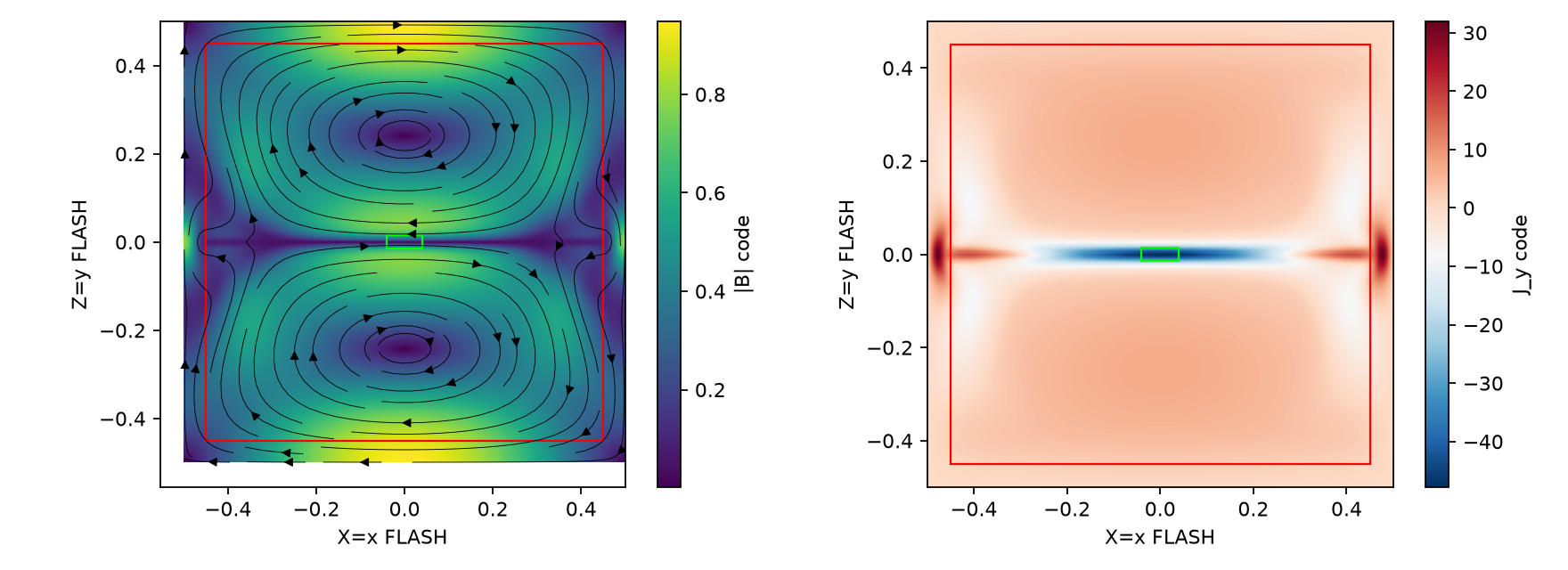
Agent-generated view of the actual \(512^2\) FLASH source. The red rectangle marks the enlarged kinetic domain; the green rectangle marks the pressure measurement region. Coordinates and fields are normalized. This is recorded exploration.
The operator supplied a resistive island-coalescence application and working transfer helpers. GPT-6.1 Sol at high effort served as worker, with a separate Sol-high review context. The agent chose a fresh source trajectory, source time, physical mapping, local region, diagnostics and numerical controls.
The proposed observable is the local departure of each species’ pressure tensor from its isotropic part,
The hypothesis requires its area/time average to remain at or below 0.20 for both species, over a qualified interior window lasting at least \(0.5\,\Omega_{ci,\mathrm{ref}}^{-1}\). The chosen window was \(t\Omega_{ci,\mathrm{ref}}\in[0.3,0.8]\).
This is a finite initial-value problem: reduced mass ratio \(m_i/m_e=25\), initial \(T_i/T_e=1\), and an explicitly chosen SI mapping. It does not test a universal reconnection rate or radiation production. A small averaged tensor departure alone also does not establish that the omitted tensor-gradient terms are unimportant to the reconnection electric field.
What actually connected the solvers
FLASH: fresh \(256^2\) and \(512^2\) trajectories from the supplied normalized resistive-MHD model. The selected fine snapshot is at code time 0.8001113920.
Source qualification: measured sheet half-width changed about 1.9% under refinement and spanned 7.41 fine source cells. Recorded density, pressure, magnetic-field and flow comparisons were inspected during methods review.
Transfer: the agent retained the source HDF5/NPZ identities, rotated \((X,Y,Z)=(x,-z,y)\), and transferred density, pressure, bulk flow and current. A discrete curl supplied the kinetic magnetic field. The recorded magnetic mapping discrepancy was approximately \(3.25\times10^{-4}\) RMS.
WarpX: CUDA particle calculations evolved these transferred data, using paired neutral loading and species drifts that preserve center-of-mass flow while representing the current. The study collected local pressure tensors, fields, particle counts and energy diagnostics.
The relationship is one-way initial-state transfer. WarpX evolves a collisionless model and does not retain FLASH’s scalar resistivity. Neither source resolution nor successful field transfer establishes kinetic equilibrium; initial relaxation and boundary effects need separate checks.
Numerical work and outcome
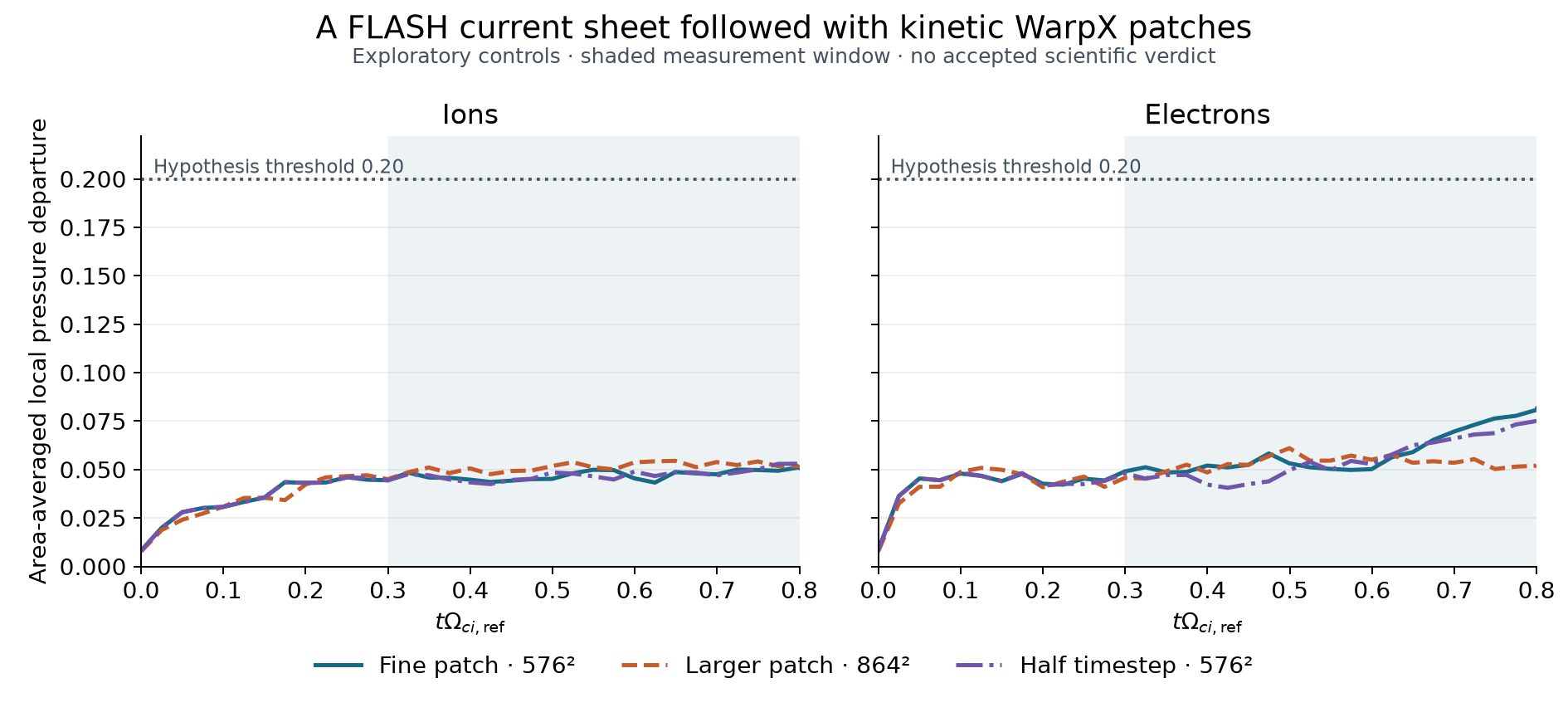
Post-run editorial plot of the agent’s preserved analysis arrays. The shaded region is the declared measurement window. All curves are exploratory controls; the original source and figures remain in the audit.
Control |
Recorded result |
|---|---|
Initial base/larger patches |
Both reached the full window; approximately 7 and 13 minutes under concurrent GPU use |
Particle count |
Doubled particles on the coarse grid; the measured departure changed, so sampling could not be ignored |
Fine patch |
\(576^2\), completed in 258 seconds after GPU layout optimization |
Half timestep |
Full window completed in 573 seconds |
Matched enlarged domain |
\(864^2\) at the same physical cell size, completed in 554 seconds after batching particle loading |
Final fresh-seed attempt |
Cancelled by the worker after recognizing that completion plus review could not fit the remaining budget |
Total executions |
32 succeeded, 6 failed, 2 cancelled, including preparation and analysis |
Scientific disposition |
Unresolved; no accepted claim review |
The final exploratory comparison reports average departures of approximately 0.047/0.058 for ions/electrons in the fine patch, 0.051/0.053 in the enlarged domain, and 0.047/0.055 with half the timestep. These values are below 0.20, but the study did not complete fresh reviewed validation and scientific adjudication. The changed loader and fine-scale particle/seed qualification also required explicit treatment; the coarse particle control is not automatically a complete qualification of the finer grid.
Several failures were informative. The worker repaired installed-API and JSON serialization errors, stopped an unaffordable concurrent refinement, reduced GPU box overhead, and recovered from the enlarged loader’s resident-memory limit. The original worker report remained stale in places; final receipts and the host’s cutoff disposition take precedence over intermediate prose.
Inspect and reproduce
The demo sources and compact audit include the operator hypothesis, instructions, commissioned helpers, all 40 execution receipts, methods/director decisions and compact retained outputs. The 581-file extract omits bulk fields, large transferred arrays and native provider streams, with declared-artifact hashes preserved. It is not a complete portable numerical replay package.
uv run python scripts/verify_research_audit.py demos/flash_warpx_kinetic_patch/record
uv run --extra flash-demo python demos/flash_warpx_kinetic_patch/plot_record.py
The first command verifies retained bytes and recorded dispositions without a model call or installed solvers. The second redraws the pressure comparison from the retained measurements. Fresh simulations require operator-supplied FLASH, qualified WarpX and an agent backend.
The two-hour campaign launched from source commit
32f500f2dcab29353f7943eb6205c24cd2e3d893, a development checkout based on 0.6.0.
Reported native counters totalled 17,660,611 input tokens, including 15,668,992
cached tokens, and 131,631 output tokens. Six turns have incomplete reporting;
these are usage counters, not an invoice. Another research campaign used the
same machine during part of this run.
The design is motivated by Li et al. (2023) and Makwana et al. (2017). Those papers implement embedded/two-way MHD–PIC approaches; this demo does not implement their coupling algorithms or inherit their validation. See multi-tool studies for the general handoff rules.