Does energy conservation guarantee an accurate orbit?
The original claim was falsified. A narrower, prospectively committed claim passed independent review after four fresh numerical experiments. The study finished in 6 minutes 40 seconds, within its 20-minute budget.
This is a small, inspectable example of the counterexample-and-repair loop. It reproduces a numerical pitfall in ordinary CPU Python: small energy error can coexist with a growing orbital phase error. Its purpose is to expose the research process, rather than claim a new result in celestial mechanics.
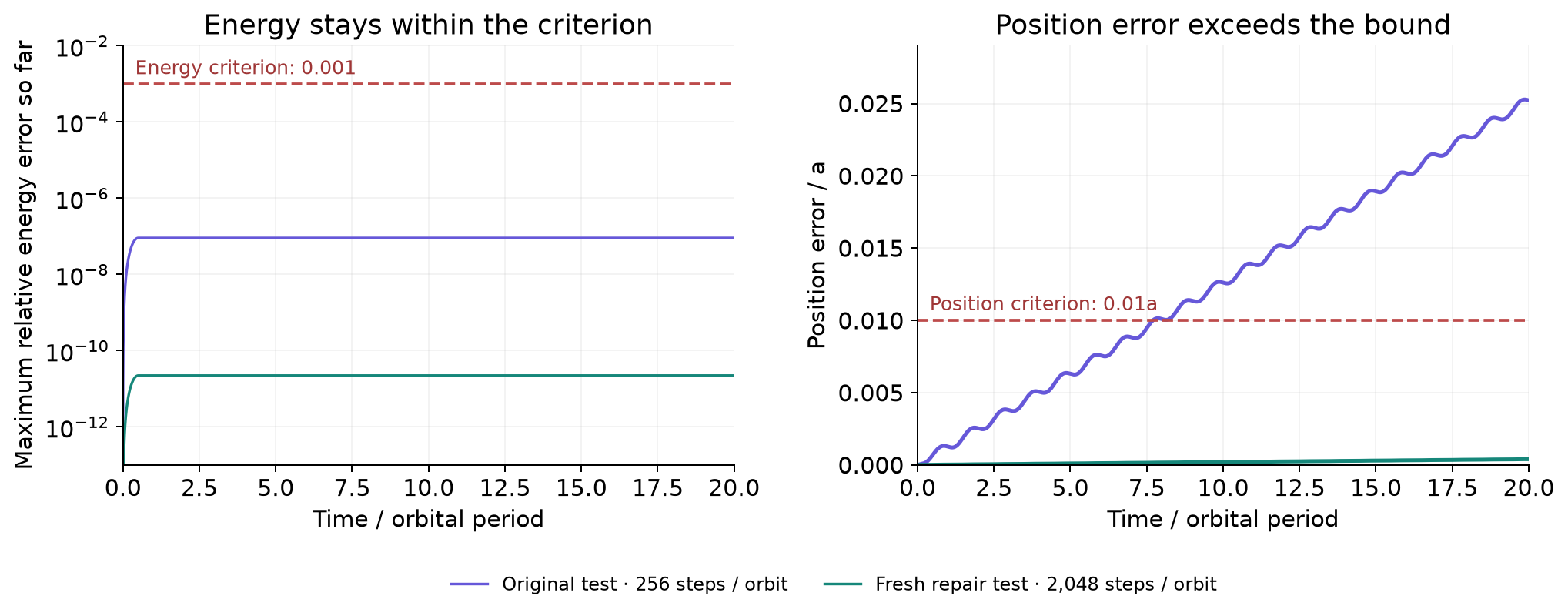
Circular orbit, twenty periods. These curves were drawn after the investigation from its preserved arrays. The violet curve is an original counterexample; the green curve is one fresh validation case for the revised claim.
The question and the counterexample
The operator specified a planar Kepler problem with \(GM=a=1\), a periapsis start, and a kick–drift–kick leapfrog integrator. The original domain was the twelve combinations of eccentricity \(e\in\{0,0.3,0.6\}\) and \(N\in\{64,128,256,512\}\) steps per orbital period, integrated for twenty periods.
The hypothesis was an implication: if the maximum sampled relative energy error stays below \(10^{-3}\), the maximum position error at the same times stays below \(0.01a\).
The agent implemented the solver, checked an exact Kepler reference against an independent high-accuracy integration, and ran the full twelve-case matrix. Six cases met the energy criterion; five of those violated the position bound. One particularly clear example is:
Circular orbit, 256 steps per period |
Measured maximum |
Proposed bound |
|---|---|---|
Relative energy error |
\(9.06374\times10^{-8}\) |
\(10^{-3}\) |
Position error / \(a\) |
\(0.0252822\) |
\(0.01\) |
The reviewer checked the source, retained trajectories, leapfrog update,
invariants and the analytic circular reference. It accepted the root falsification
in review_9e9e9a5528a825b402183851, based on
exp_70ff32e6d28ef9ccd7312295.
What changed, and what was tested again
The repair replaced the energy-only implication with explicit resolution and position-accuracy requirements for four named cases. It was recorded before the validation runs. The agent also corrected an initial command binding before running the tests; both commitments remain in the record.
Eccentricity |
Steps per period |
Maximum position error / \(a\) |
Maximum relative energy error |
|---|---|---|---|
0 |
2,048 |
0.000395134 |
\(2.22\times10^{-11}\) |
0.3 |
2,048 |
0.00154621 |
\(5.12\times10^{-6}\) |
0.6 |
4,096 |
0.00642788 |
\(1.74\times10^{-5}\) |
0.6 |
8,192 |
0.00160695 |
\(4.36\times10^{-6}\) |
All four met the committed limits. A separate challenge at \(e=0.6\), \(N=2048\) failed the position requirement despite passing the energy criterion. That case lies outside both the original twelve-case matrix and the revised four-case claim; it is useful context, not a counterexample to the accepted repair.
The reviewer accepted the repair in review_91da2f71f73cfdcb1b8e34d6. Its support
is limited to these cases and sampled times. The record establishes neither a
minimum resolution rule nor accuracy for every eccentricity or future time.
Inspect or reproduce it
The source record contains the operator’s hypothesis and instructions, six experiment receipts, original numerical code and arrays, both commitments, both reviews and the generated study ledger. No API key is needed to inspect it.
From a repository checkout, verify the retained hashes, numerical measurements and review/commitment relationships:
uv sync --frozen
uv run python demos/kepler_energy/verify_record.py
Rerun the original twelve-case experiment into a new directory:
uv run python demos/kepler_energy/reproduce.py \
  --experiment exp_70ff32e6d28ef9ccd7312295 \
  --output artifacts/kepler-reproduction
This executes the retained numerical program; it does not call an agent or create a new accepted scientific verdict. To start your own autonomous investigation, follow the first-study tutorial.
Who did what, and what it cost
The operator supplied the question, original finite domain, reference checks and budget. GPT-6 Luna, medium effort, implemented the numerical work and chose the repairs and follow-up experiments. GPT-6.1 Sol, high effort, reviewed in a separate context. The host recorded the experiments and enforced fresh evidence for committed repairs. The explanatory figure and this page were prepared after the run; they do not replace its original record.
The run used minimal mode with the repair completion policy and source commit
09ddd7a51387124b5e2ed38d254f76b601f9aa11, a development checkout based on
0.6.0 with the ancestor-review scheduling fix. Python, dependency and model
identities are frozen in record/manifest.json; future package releases do not
change this study’s identity.
The six numerical jobs took about 13 seconds in total. The 400-second campaign also includes agent reasoning, tool calls and review. Native session counters reported 1,526,631 input tokens, including 1,382,016 cached input tokens, and 17,834 output tokens. Two turns have incomplete usage reporting, so these counters are not a complete billing statement. OAuth usage is not converted into a hypothetical dollar charge.
An earlier attempt exposed a harness defect: a repair review was scheduled before its parent falsification, repeatedly rejected at the ancestor gate, and retried. The operator stopped that attempt, fixed the dependency ordering, and launched this study in a new directory. The manifest preserves the failed attempt’s summary; it is not counted as part of the successful run’s time or usage.
The agent’s research/RESULTS.md was written before the final review and still
mentions a pending check. It is preserved verbatim. The accepted review receipts
and research_report.json record the completed outcome.