Recorded investigations
These examples let you inspect the research process: the operator’s question, what the agent chose to run, the resulting data and the review decisions. A preserved study can be read without an API key. Fresh agent runs need a configured backend; numerical reproduction and record verification are separate operations.
Plasma research
Start with the pictures: both plasma walkthroughs include actual field maps, evidence maps, short explanations of each measurement and downloadable figures. Their linked receipts distinguish completed work from outstanding tests.
Magnetic-island coalescence with FLASH investigates reconnection-rate scaling in a 2D resistive-MHD model. The classic campaign, original field figures and later statistical correction remain available. A separate one-hour minimal run used the same commissioned instrument and remained unresolved after its eligibility checks. A post-run coordinate correction explains false diagnostic rejections; the original decisions and partial results remain preserved alongside the classic record.
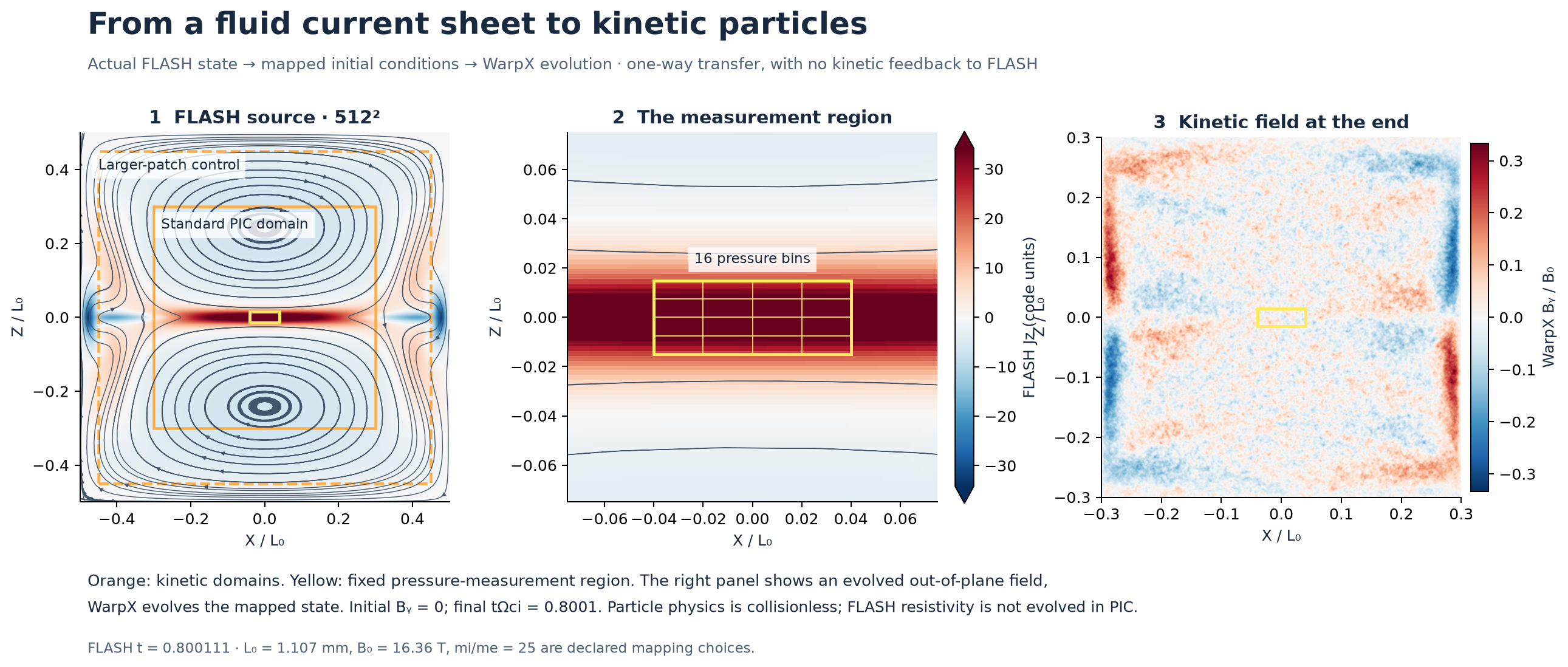
A FLASH current sheet followed with WarpX connects a fresh MHD source to local kinetic calculations. Its two-hour record includes actual state transfer, GPU performance recovery and completed numerical controls, with the final scientific question left unresolved.
A complete minimal-workflow example
Does energy conservation guarantee an accurate orbit? uses a fresh Kepler simulation study to exercise counterexample search and the repair completion policy. Ordinary CPU Python is enough. It falsified the original claim and supported a four-case repair after fresh validation. The record identifies human framing, agent work, independent reviews and the observed outcome.
Historical autonomous records
Record |
Workflow and purpose |
|---|---|
Version 0.1 classic campaign: finite-domain pattern counterexample and a refused claim closure followed by fresh evidence |
|
Historical guided plasma campaign with its original qualification and interpretation limits |
These records preserve the original behavior and results. They are useful for following the development of the evidence system; they are not presented as fresh runs of the current default workflow.
Research audits
Longer investigations also produce useful records when they leave a question open. The adaptive aluminium Z-pinch audit examines actual 3D trajectories, energy diagnostics, unresolved reconnection attribution and the cost of the research process. Its data and limitations are kept with the original dated report.
To contribute a study, include the operator input, version and source identity, actual run records, verification instructions and a clear account of who did which work. See documentation development.