Run experiments on local and SSH workers
Execution pools extend minimal-mode studies with local and SSH numerical workers. Install the current stable workspace or matching Python package on the coordinator.
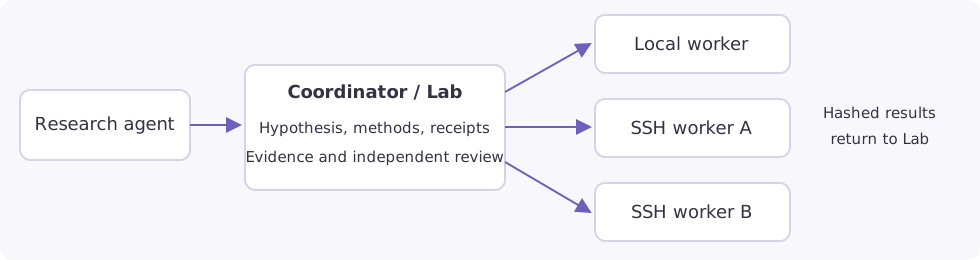
One Simjecture workspace owns the research agent, hypothesis, methods, reviews, experiment receipts and deadline. Each selected machine runs a headless execution worker. A worker needs Python and the numerical runtime, but no model subscription, provider key, web server or copy of the research supervisor. Local and SSH workers share the same versioned execution protocol and numerical launcher.
Prepare through the workspace
Open Machines → Add machine. Enter an SSH address and password, then click Connect & prepare. Addresses can be a normal command such as
ssh -p 23 root@host,user@host:port,ssh://user@host:portor an SSH config alias. An empty password uses your existing key/SSH agent.Preparation runs in the background. It detects the login account, visible CPU/RAM/GPU resources, chooses conservative budgets and a persistent worker directory, installs private Python 3.12, and verifies the numerical launcher. Root logins prepare an unprivileged
simjectureworker account. Bubblewrap is preferred; restricted containers select cooperative PRoot only when its probe succeeds under the unprivileged worker account. If both backends are blocked, preparation fails with a setup error. Root Debian/Ubuntu hosts can install the missing execution dependency. Other hosts show an actionable setup error when installation needs additional privileges.Advanced settings are optional. Override the display name, directory, resource budget, GPU IDs, execution environment, key path or instrument directories. Blank resource fields mean automatic detection;
nonein GPU IDs explicitly chooses CPU-only execution. Existing manual installations retain their paths and budgets when you edit settings.Machine cards show Online, Offline, Preparing, setup errors or stale checks, plus resource budgets, active jobs and the last-check age. The server sends lightweight heartbeats every 30 seconds, even when no browser is open. Heartbeats do not launch numerical jobs or rehash solver installations. Refresh checks availability immediately. A study launch still performs its full checks.
Prepare with agent opens a setup conversation with the registered machine selected. Choose your agent/model and send the prepared request. The agent can inspect the host, prepare the managed worker, run recorded SSH setup commands, and register actual instrument descriptor directories using the saved connection. Passwords are not placed in its prompt or tool arguments. Native CLI agents use the same workspace Python bridge. Scientific solvers, source views and tables must be registered on the worker; worker preparation does not download FLASH or copy licensed tables between machines. The worker account needs read/traverse access to every registered runtime and mount.
In Autonomous research, select the prepared workers under Experiment machines. Use minimal mode. Add this computer provides a managed local worker with one click. An empty study selection retains the existing local execution path. Machine Jobs shows readable receipts and cancellation controls.
Basic onboarding enrolls a new host key into a private, coordinator-managed
known_hosts file on first connection; subsequent key changes are rejected.
Existing manually configured SSH profiles retain strict pre-enrolled host-key checks.
The study and monitor show placement, remote job ID, GPU assignment and unreachable transport. Declared outputs appear in study results; recorded files held remotely have a Retrieve action. Direct and agent-guided continuation preparation retain registered machine selections. You can change the selection before launching the new phase. Register the parent’s machine IDs first when importing an external study.
Prepare through the CLI
Install simjecture[workspace] on the coordinator.
This includes the process monitor and the built-in API agent used in the example.
A coordinator using only native CLIs can use the smaller process extra; managed
local workers also need the process monitor.
Create node-a.json, substituting your host, login, paths and capacity:
{
  "id": "node-a",
  "label": "GPU workstation",
  "kind": "ssh",
  "host": "compute.example.org",
  "port": 22,
  "user": "research",
  "root": "/home/research/simjecture-worker",
  "python": "python3",
  "config": {
    "execution_backend": "bubblewrap",
    "cpus": 8,
    "memory_mb": 16384,
    "gpu_ids": ["0", "1"],
    "max_jobs": 2,
    "capabilities": ["/home/research/capabilities"]
  }
}
simjecture machines --registry ./machines add --file node-a.json
simjecture machines --registry ./machines prepare node-a
simjecture machines --registry ./machines check node-a
simjecture machines --registry ./machines status node-a

simjecture study --campaign ./runs/parallel-study \
  --hypothesis-file hypothesis.txt --instructions-file instructions.md \
  --mode minimal --backend builtin --model YOUR_MODEL \
  --provider-config /private/provider.json --wall-seconds 3600 \
  --machine-registry ./machines --machine node-a --machine node-b
Add and prepare node-b before selecting it. To include the coordinator as a
managed execution worker, register kind: "local" with an absolute worker root
and the Python executable from its installed environment.
Optional profile fields are identity_file, known_hosts, control_path and
run_as. OpenSSH multiplexing reuses connections automatically when no control
socket is supplied. Password authentication is supported; saved passwords stay in
mode-0600 private coordinator files, outside profiles and study manifests. Prefer
the GUI password field over putting a credential in a shell command or profile file.
Submit and inspect experiments
The generated lab.py client exposes the pool without changing hypothesis or
review rules:
from lab import lab
print(lab.machines())

receipt = lab.run(
    "calculation.py",
    inputs=["input.json"],
    outputs=["result.json", "figure.png"],
    capability="warpx-cuda--at-node-a",
    stage="exploration",
    resources={"cpus": 2, "memory_mb": 4096, "gpus": 1},
    timeout=600,
    key="commission-1",
)
print(lab.status())
Use an alias advertised by lab.machines(). An alias is bound to its worker;
plain Python jobs choose a worker automatically unless machine="node-b" is
specified. Submit multiple asynchronous jobs to obtain parallel execution.
Requests queue when their CPU/RAM/GPU reservation or concurrency slot is busy.
GPU IDs are distinct physical devices, verified at readiness. Assigned devices
set CUDA_VISIBLE_DEVICES; CPU-only jobs receive an empty value. A CUDA capability
must mount all devices that may be allocated to it. CPU counts are admission
reservations, not OS CPU quotas; request enough cores for MPI ranks and threads.
For single-node Open MPI, launch through the installed helper inside the experiment:
import os, subprocess, sys
subprocess.run([
    sys.executable, os.environ["SIMJECTURE_MPI_HELPER"],
    "--ranks", "16", "--", "./flash4",
], check=True)
Request resources={"cpus": 16, "memory_mb": 49152, "gpus": 0} for that example.
The helper supplies the reserved localhost slots and rejects excess ranks rather
than oversubscribing. It covers single-node Open MPI, not distributed MPI or other
MPI implementations. A successful one-rank smoke test does not qualify a 16-rank
launch: commission the exact worker, rank count, runtime and input bundle.
Source and dependency views are read-only. Inspect them through the bounded helper:
lab.read_instrument(capability="flash--at-node-a", root="runtime", path=".")
lab.read_instrument(
    capability="flash--at-node-a", root="runtime",
    path="source/Simulation/SimulationMain/example.F90", max_bytes=16000,
)
lab.fetch_remote(experiment=receipt["id"], path="diagnostics/fields.h5")
Choose a registered readable_roots entry for a source mount. Only declared outputs,
input programs and small text diagnostics are imported automatically. Other recorded
arrays remain on the worker until explicitly retrieved. Transfers are chunked and
SHA256-verified; a solver exit or a transferred file never grants scientific approval.
Large explicitly declared outputs are transferred even when they are arrays.
On filesystems with unstable directory inodes, the operator can provide a
.simjecture-source-manifest.json inside a reference dependency root. It maps
declared source paths to SHA256 hashes. The harness verifies every listed file’s
bytes and uses the manifest content as identity instead of device/inode numbers.
Keep the manifest and reference root protected by host permissions. It covers the
listed files, not unlisted additions. Symlink escapes, changed bytes and malformed
hashes fail validation. Introducing it changes the capability identity: qualify a
new phase/profile rather than changing an existing frozen study. Legacy references
without it retain their existing identity semantics.
Recovery, deadlines and boundaries
Job identity includes a persistent study UUID and the frozen experiment request. Lost upload/submission replies replay the same job. A coordinator restart reattaches to its detached worker process. An unreachable SSH transport remains distinct from an experiment failure; restored credentials or connections recover the existing job.
Queueing and network waits count against the original absolute study deadline. Workers enforce that deadline without the coordinator. If it expires while SSH is unreachable, the coordinator records an unconfirmed stop rather than claiming a verified cancellation. Explicit cancellation terminates recorded descendants and retains reservations while stopping is unconfirmed. A worker crash produces an interrupted receipt; a reboot does not silently rerun the same job.
Worker code, configuration, identity and runtime hashes are frozen for the phase. Keep old worker program generations and job directories for retrieval. Drain active jobs before changing worker configuration; changing routing requires draining active studies. Renewing authentication does not change experiment identity. Use a new phase to select changed workers or instruments.
Restricted GPU containers may require explicit proot-cooperative selection. It
provides filesystem views and execution limits, but no kernel or network isolation;
use trusted workers and programs. Native agent tools remain available on the
coordinator. This feature currently covers minimal-mode numerical experiments;
interactive chat simulations, remote agent hosting and Slurm submission are separate
paths.
For a trusted host where PRoot interferes with MPI, Machines → Settings → Advanced
settings → Experiment environment → Native process explicitly selects
process-cooperative. This runs under the unprivileged worker account with host
filesystem and network access. It retains frozen-input checks, deadlines, sampled
aggregate RSS limits and receipts, but supplies no OS isolation. Registered runtime
and source files need host permissions to remain read-only. Automatic detection does
not select this backend. See restricted hosts.
Earlier studies retain their frozen backend and worker configuration when the coordinator is upgraded.
Create a separate machine profile and worker root when changing an execution backend that old studies have frozen. Keep the original profile and program generation for retrieval. Profiles for the same SSH address/port share physical capacity: a study cannot select both, and an active reservation on either prevents allocating through the alternative. DNS aliases are not resolved into one physical-host identity.
Relationship to Simote
Simote and Simjecture remain independently usable. This pool uses ordinary OpenSSH and can run from a coordinator deployed by Simote. It does not require a master/slave Simote installation or a second research scheduler. Existing Simote agent-role and Slurm integrations remain separate; this change does not add a Simote profile importer or a Slurm worker adapter. See Simote agent roles.
See the two-host acceptance record for the actual numerical, solver, recovery and interface checks.