Historical record: collisionless GEM reconnection
Note
This record uses the version 0.1 classic workflow. Its original scientific scope and audit corrections remain in force. See recorded investigations for a current minimal-mode example and other research records.
This completed 177-minute campaign is the primary version 0.1 plasma demonstration. It used a two-dimensional, three-velocity, fully kinetic collisionless Harris sheet following the geometry and normalization of the GEM magnetic reconnection challenge. The operator supplied a validated CUDA/openPMD starting instrument; the agent chose and froze a fresh held-out ensemble design before producing claim-bearing outcomes.
The starting instrument cites the GEM challenge and the 0.1-rate review as contextual references. The run’s literature search was preserved but was not eligible as scientific evidence for the active claim.
In two-dimensional, non-relativistic, fully kinetic, collisionless electron-ion
GEM-type Harris-sheet reconnection at reduced mass ratio 25 and the fixed
physical geometry and normalization of the supplied guided regime, the
seed-ensemble mean late-window normalized flux-slope reconnection rate at
Ti/Te = 1 is at least 25 percent larger than at Ti/Te = 20
(mu_1 / mu_20 >= 1.25), and this endpoint contrast persists under a
numerical-fidelity control.
The supplied anchor, its output, and three prior campaign audits were marked
non-evidentiary. Seed 20260814, which motivated the endpoint claim, was
excluded. The agent selected fresh paired seeds 20260902, 20260903, and
20260904, ran both temperature endpoints at 16 and 8 particles per cell per
population, and commissioned separate simulator and analyzer claims.
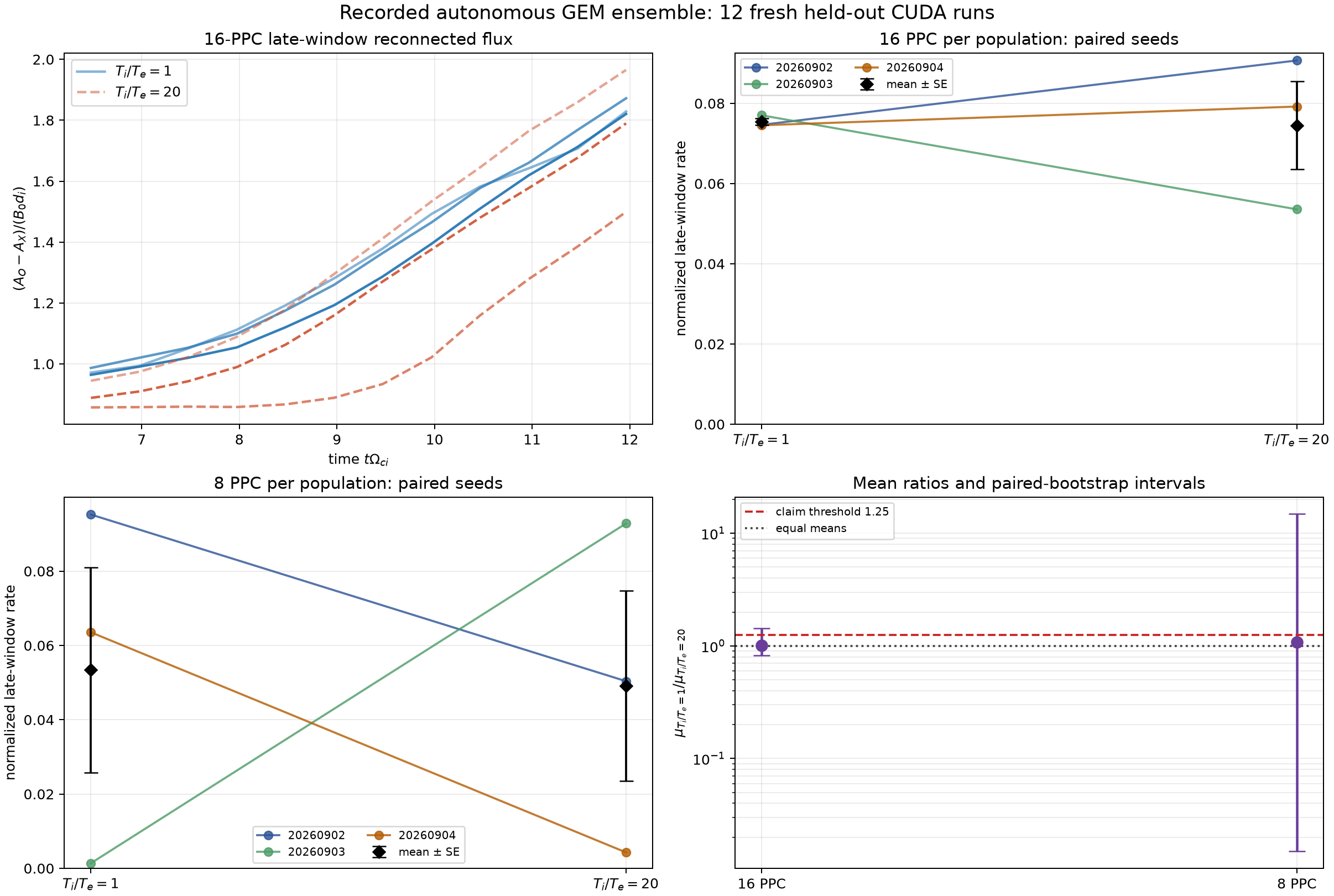
The 12 fresh CUDA simulations. The red dashed line marks the claimed ratio threshold of 1.25; the dotted line marks equal endpoint means.
Simulation and evidence contract
Property |
Recorded value |
|---|---|
Representation |
2D3V; four fully kinetic electron/ion populations |
Algorithms |
explicit Yee fields; Esirkepov current deposition |
Domain |
|
Plasma |
|
Normalization |
|
Resolution |
|
Integration |
4,623 steps; |
Duration |
|
Boundaries |
periodic in |
Decisive window |
OLS flux slope for |
Energy gate |
absolute combined field-plus-particle drift |
Uncertainty |
paired, 100,000-resample seed bootstrap |
Each of the 12 simulator summaries passed 26 five-aspect checks. Every run
passed its energy gate; the maximum absolute combined drift was
4.8429 × 10^-4. At 16 PPC each run represented 2,097,152 nominal
macroparticles. The scientific simulations reported 6,378.7 seconds of
aggregate CUDA execution, within 10,619.9 seconds for the complete 75-turn
campaign.
Result and guarded interpretation
Fidelity |
mean rate, |
mean rate, |
ratio |
bootstrap 95% interval |
|---|---|---|---|---|
16 PPC |
|
|
|
|
8 PPC |
|
|
|
|
The frozen finite-sample rule falsified the operational child because the
valid 16-PPC group had R16 < 1.25; the 8-PPC point estimate also fell below
the threshold. The population statement remains unresolved because only three
seeds were sampled and the 16-PPC bootstrap interval includes 1.25. The 8-PPC
results are extremely seed-sensitive.
○ claim_root                              open
└─ × claim_confirm_seed_ensemble          falsified
   ├─ ✓ claim_instr_simulator             supported
   └─ ✓ claim_instr_analyzer              supported
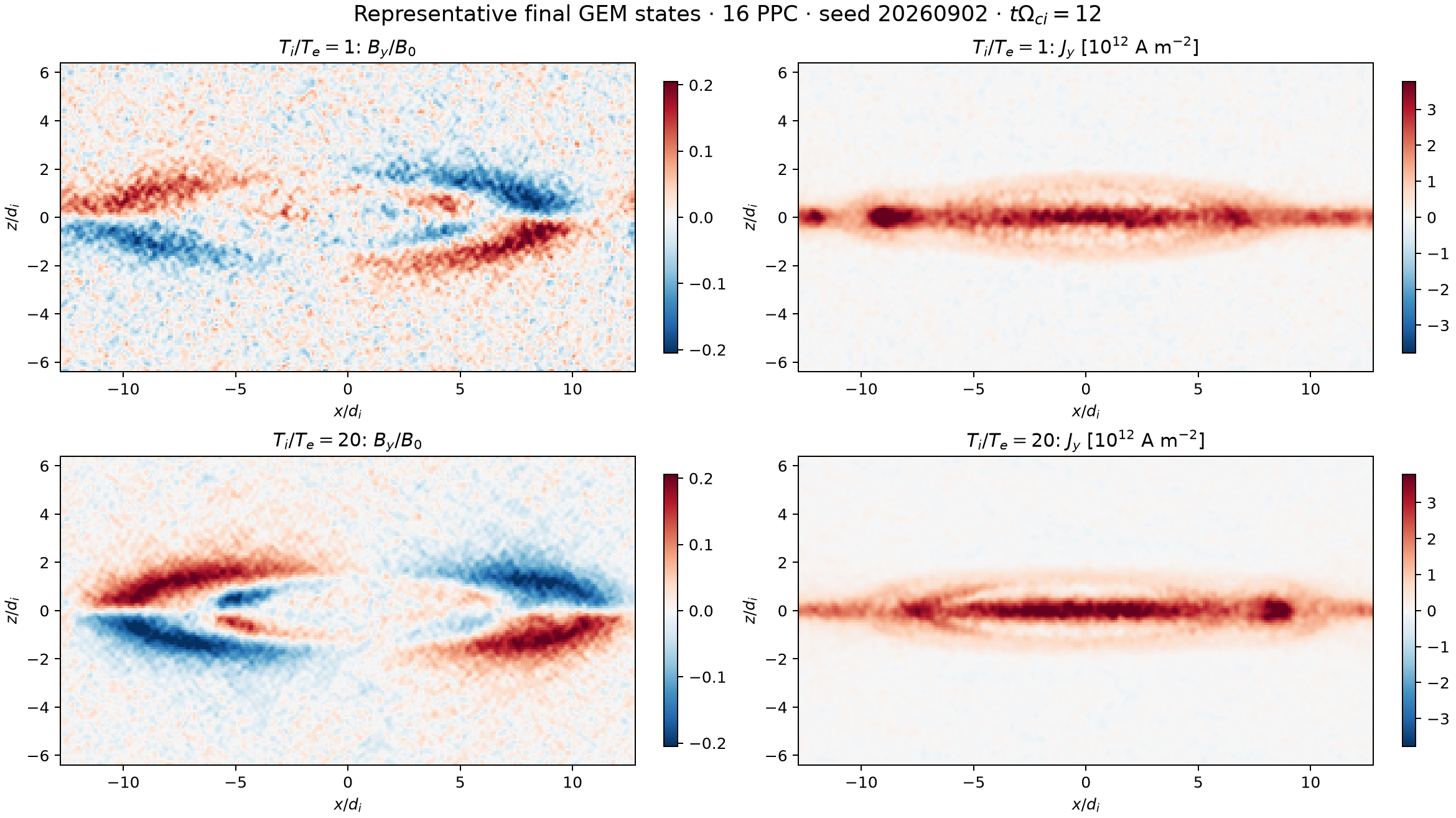
Exact archived final states for the 20260902 pair at 16 PPC and
t Ω_ci=12. These representative fields are visual context; the contracted
claim used the complete seed ensemble and flux histories.
Audit the preserved campaign
The repository contains the full top-level audit record plus 60 hash-verified workspace artifacts, including every scientific summary and two representative final-field arrays:
uv run simjecture status demos/collisionless_gem_reconnection/record
uv run python demos/collisionless_gem_reconnection/verify_record.py
uv run simjecture web demos/collisionless_gem_reconnection/record --read-only
uv sync --extra tui
uv run simjecture tui demos/collisionless_gem_reconnection/record
The original 893,147,359-byte workspace contained 482 artifacts. Bulk raw openPMD histories are excluded from Git, but the committed provenance map retains their names, sizes, hashes, commands, and claim relationships. See the complete demo guide for the exact autonomous launch input and guided commissioning package.
Limits of the result
The run used guided autonomy and a known-runnable simulator, not instrument invention from the hypothesis alone.
Its scope is one 2D, reduced-mass-ratio, fixed-geometry regime through
t Ω_ci≈12.Three seeds and two particle counts do not establish a population contrast or numerical convergence.
The terminal prose overgeneralized the operational falsification; the durable ledger correctly leaves the immutable root open.
Full raw-data reproduction still needs an external archive with a permanent identifier.